
Digital evidence in crypto cases: how to record, label and arrange it for police, platforms and court
Published: Last reviewed: Editorial standards
Evidence that serves a procedure is usually captured early, stored without alteration, and labelled with who collected it, at what time and by what method. It should be arranged so that a stranger can follow it. We assist with collecting and indexing chats, screenshots, statements and transaction records, and we coordinate independent forensic specialists where a formal capture is required. We cannot promise that any court, police unit or platform will accept the material.
Any question on your case may be put to us here:
Who this service is meant for
- A police report is planned, and your screenshots, chat logs and records need to be organized first
- You are filing an appeal with an exchange or a bank and require a clean, indexed evidence pack
- Your lawyer has requested original files together with a record of how each was obtained
- A scam website, profile or chat could vanish and you wish to preserve it correctly
- Key messages are stored on a phone or laptop and you want to avoid damaging them
The procedure for a case
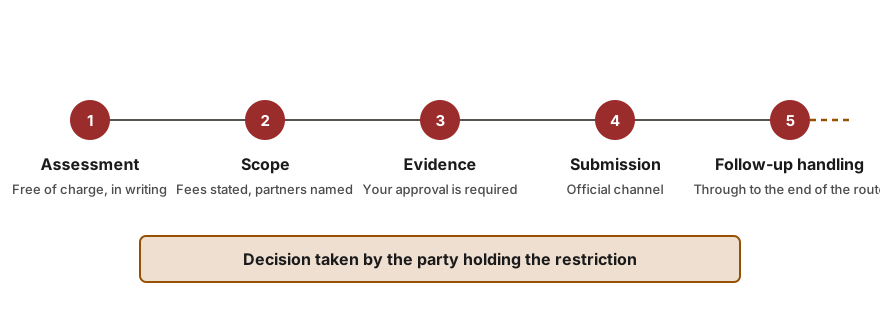
- Free initial assessment
You explain the case and what material you hold. In reply, we set out in writing which items carry the most weight, which risk disappearing, and whether a formal capture appears worthwhile.
- Scope and fee in writing
When you move forward, you are provided with a written document listing the scope of work, the assigned specialists, and the fee structure. Any forensic data collection is listed separately in that document.
- Gathering and recording evidence
You submit materials through a secure channel, or you capture them using our checklist. Each item is logged by us, and we mark gaps, duplicates and conflicts.
- Formal capture when required
Specialists who are independent record the pages, accounts or devices that require it, keeping a method note and hashes. Their output is then reviewed by us against your scope.
- Handover
You receive an indexed pack, the log, and a brief guide explaining submission. We assist with sending it and respond to questions from the recipient.
What to prepare
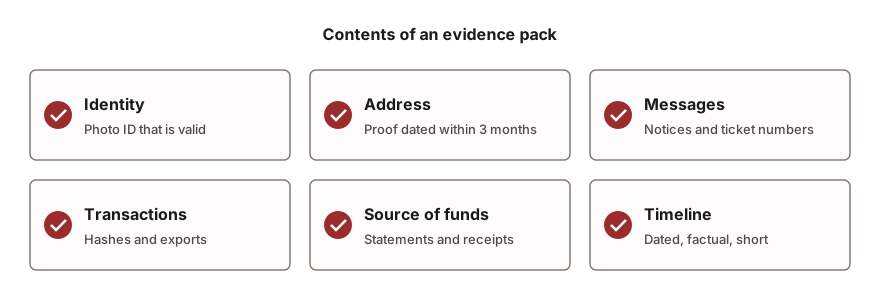
- Original files, including photos, PDFs, emails and chat exports, not merely screenshots of those files
- Device and application information: model, app names, usernames, and phone numbers involved
- Web addresses of the scam site, profiles involved, and pages you visited
- Statements from exchanges, wallets and banks, with dates clearly visible
- Transaction hashes and wallet addresses
- Report numbers from the police and ticket references from the platform
- A timeline you have written yourself
- Translations or explanatory notes for material not in the language of the proceeding
What our work involves
- Explain what to preserve and what to leave untouched
We provide a brief written checklist: keep all chats, do not reset the phone, do not alter files and never crop originals. Copies may be adjusted for presentation, but the originals remain unchanged in every respect.
- Record and log every item
Each entry is logged with what the item is, its origin, who captured it, the date and time, and the method used. In practice, this record is often what makes a screenshot credible to a reviewer rather than a mere image.
- Coordinate evidence capture with independent experts
When material might disappear or be contested later, independent forensic specialists may preserve web pages, accounts or devices using documented procedures and record a hash for each file. Our role is to brief them, settle the scope with you in writing, and then review the record they produce before it forms part of your submission.
- Assemble the evidence file
The bundle is indexed for you: it contains a timeline, numbered exhibits, a transaction table and a brief cover note. Translations and redactions are labelled accordingly, and the originals stay available.
- Shape the pack for its reader
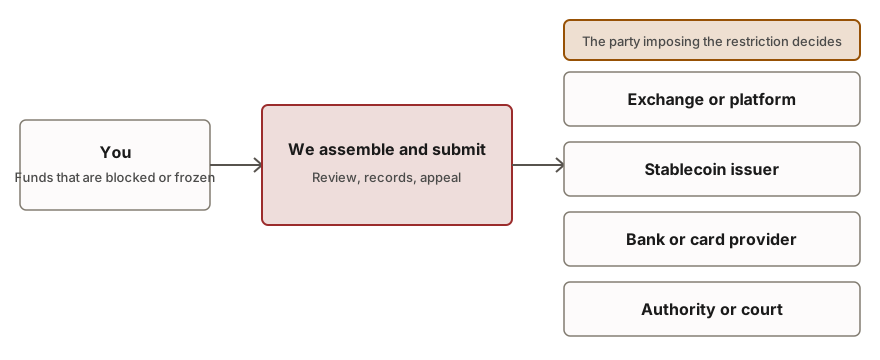
Each recipient expects a different format: a police unit, an exchange compliance team and a court rarely accept the same pack. We adjust it to each recipient, verify that names, dates and amounts match across the record, then deliver the final version to you or your lawyer.
What falls outside our role
- No one on our side can compel a court, a police unit, an exchange or a lawyer to accept the evidence. Rules on whether evidence is admitted, and how much weight it carries, differ by jurisdiction.
- Formal captures are prepared by independent forensic specialists, and each specialist signs the resulting report. We do not perform these captures and we do not sign them.
- We do not create, alter, backdate or improve any item. Where a record is absent or damaged, that fact is noted on the record.
- Because this service does not engage in legal practice, matters concerning required disclosures, including their required form, fall to your lawyer.
- We do not request seed phrases, private keys or passwords, and no one on our side needs remote access to your device.
Expected timeframes
Work on collection may begin the same day on which you forward the first items, and a well-organised pack as a rule takes days, not weeks. Formal capture is governed by the availability of the independent specialists and by the scope of what must be captured. Once the assessment is complete, you receive an estimate of the timeframe.
Fees
The preliminary assessment is provided at no cost. Written quotations detailing the organization of documentation and securing specialists are issued separately. No payment is required until we have determined if assistance is possible. Fees →
Frequently raised questions
Is a screenshot enough evidence on its own?
A screenshot helps, but on its own it is easy to challenge. Keep the original file, its date, the web address and the person who made it, and also preserve the full chat export. Where the content matters greatly, a formal capture performed by a specialist carries more weight.
Should I remove the app or wipe my phone?
As a rule, no. Leave the device unchanged until you know what the procedure requires. Removing apps, resetting the phone or using cleaning tools may destroy evidence. If you suspect another person can still reach the device, tell us before you alter anything.
Do you need access to my phone or accounts?
It is a written record that shows who had possession of an item, at which times, and what steps were taken with it, beginning at the moment of collection. Its purpose is to demonstrate that the item is identical to the version captured originally. The exact procedure and the required level of detail depend on the jurisdiction and on the terms you accepted.
Is capturing a scam website something you can do for me?
An independent specialist can be engaged to capture the pages in a documented manner, recording the date, address and file hashes. This should be done early, since scam sites disappear. No assurance can be given that the capture will be accepted as proof.
Must you provide access to your phone or your accounts to proceed?
No. You gather the items yourself by following our checklist, or you instruct an independent specialist who works only with your written consent and within an agreed written scope. As a rule, we never request passwords, seed phrases or remote access to your devices.
How does this differ from an expert report?
Evidence preparation covers the gathering, the preservation and the orderly arrangement of material. An expert report is an independent opinion that examines that material, for instance how the funds moved. Many cases require both, and the preparation is what makes the opinion possible.
Common situations
- Screenshots scattered through a phone gallery, without order, dates or surrounding context
- Messenger conversations with a scammer that risk deletion or account bans
- A fraudulent investment site displaying your balance, one that could vanish at any time
- Exchange statements in mixed formats and languages, with missing dates in between
- Platform emails where the headers and attached files carry weight
- A device formerly accessed remotely by someone else, now requiring careful handling
- Records in a foreign language needing a translation your lawyer can depend on
Related situations
- Expert reports for court and dispute use. Independent experts sign the report. We handle coordination, exhibits and a clarity review.
- Report on blockchain transaction analysis. A source-of-funds report based on transaction tracing, prepared in a form a compliance team can review.
- Support after a crypto scam. Structured support after a crypto scam: review, documentation, tracing and freeze requests.
- Tracing stolen crypto and freeze requests. Tracing of stolen crypto, with freeze requests to exchanges and issuers and a police filing.
Read next
Sources
Authoritative and official pages on which this page relies. Such pages are updated, so confirm the current wording at the source itself.
The content on this page is general in nature and is not legal advice.