
Circle (USDC) address blocked or frozen: what the official pages state
Published: Official pages last read: Editorial standards
Circle states that it may block the sending or receiving of USDC at an address in limited situations: legal orders, security threats, or urgent government requests. Blocklisting, as described there, is not a reversal of a transfer that has already been completed. Removal may follow once the authority has lifted its order or the security concern has ended. Where funds were moved without the owner's consent, Circle's guidance is to contact law enforcement first.
We operate independently of Circle (USDC) and have no affiliation with it. We have no ability to affect its decisions, and nothing on this page constitutes an official statement of Circle (USDC).
Any question on your case may be put to us here:
Review of the exchange's own published terms
- Per Circle's help article, it may block a single blockchain address so that it cannot send or receive USDC or EURC in certain limited circumstances, as described in the Stablecoin Access Denial Policy. [1]
- According to the article, blocklisting, also known as access denial or freezing, differs from reversing a transaction, and transactions in USDC and EURC are irreversible, meaning Circle is unable to reverse or recall a transfer once it is completed. [1]
- The circumstances listed include compliance with laws and valid legal orders issued by a recognized authority or court in the US or France, response to certain urgent government requests, and measures where Circle, at its sole discretion, judges that a security threat makes this necessary. [1]
- The article notes that transfers involving a blocked address, in either direction, may fail, and that funds tied to that address may stay inaccessible while the blocklisting remains in effect. [1]
- According to Circle, an address may be taken off the blocklist once the relevant authority formally confirms that the legal obligation or order has been lifted, or once a security incident no longer requires the restriction. [1]
- If funds were moved without your consent, the article says to contact local law enforcement as soon as possible with the sending and receiving addresses, the transaction hash, the date and time and the amount. [1]
- Per the article, law enforcement may submit valid legal process directly to Circle, which reviews it under its own policy and applicable law. [1]
- In its v2.2 announcement, Circle states that the blocklisting function of its smart contracts allows it to stop designated addresses from sending or receiving USDC and EURC, and that this operates under its Access Denial policy. [2]
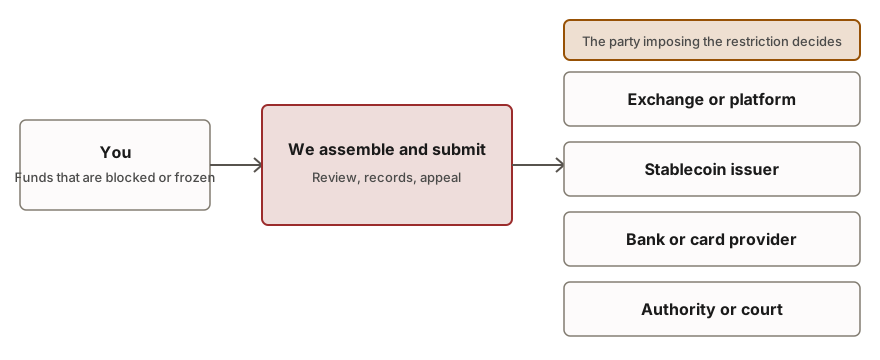
Common Regulatory Restrictions
| Type of restriction | What it means |
|---|---|
| Address frozen under a legal order | As stated by Circle, an address may be blocked on the basis of compliance with laws and valid legal orders issued by a recognised authority or court. In practice, removal occurs only after the authority confirms that the order no longer applies. |
| Freeze following an urgent request from the authority | Circle indicates that it may act on certain urgent government requests. The article does not set out the request procedure, so as a rule the route runs through the authority rather than through the holder. |
| Security threat freeze | According to Circle, an address can be blocked when the issuer, acting at its own discretion, judges a block necessary to protect the security or reliability of its network. As a rule, the block stays in place until Circle concludes that the underlying incident no longer justifies it, and the decision to lift it is made in writing on the issuer's own basis. |
| Money trapped at a blocked address | Payments into or out of a blocked address can be refused, and the balance may stay out of reach for as long as the block remains in place. In practice, Circle states that a block is not a reversal of a transfer. |
Procedure for Required Actions
- Verify that the address is genuinely blocked
Not every rejected payment points to a block. Review the transaction record and ask your wallet provider or the exchange whether the error suggests the address itself is blocked.
- Establish the basis
Contact the party that notified you, for example a platform or an authority, and ask whether the reason is a legal order, a request from government, or a security matter. Circle's article names these as the principal grounds.
- Gather proof of control and of origin
Assemble documentation showing that you hold control of the address, together with records tracing the source of the funds. Such submissions are useful with any party you approach.
- Bring in a lawyer when an order exists
According to the article, a block rests on legal obligations or orders, and it is lifted once an authority confirms those no longer apply. In practice, a licensed lawyer can contact the authority concerned.
- File a theft report with the police before proceeding
Where funds left your address without your permission, Circle recommends that you notify local law enforcement promptly, providing the addresses, the hash, the date, the time and the amount in your submission.
- Contact Circle only via its official support pages
The official method for contacting Circle is via their designated support documentation on circle.com. It is necessary to decline any links provided in unsolicited correspondence.
What to prepare
- The frozen address, with the token named in written form
- Transaction hashes together with dates, times and amounts
- Evidence of your ownership of that address
- Documentation tracing the origin of the frozen funds
- Any written notice or order you have received from the exchange, the issuer or an authority
- A police report number, in cases where the funds were transferred without your authorization
Potential Hazards and Fraud Prevention
- Never disclose your seed phrase, private keys, or passwords to anyone alleging they can clear a blocklist.
- Do not remit payment to individuals who promise swift removal of restrictions. Such removal is typically determined by an authority or a security incident, not a transactional service.
- Avoid engaging with platforms requesting wallet connection for status checks or address unlocking, as these sites pose a risk of draining your stored funds.
- Treat any unprompted message promising recovery of stolen USDC with caution. Circle states in writing that a completed transfer cannot be reversed or recalled.
Circumstances Requiring External Counsel
- An investigative body or a specific legal order appears to be responsible for the address being restricted.
- The restriction is in place against a substantial balance, yet the party imposing the restriction remains unidentified.
- For an authority or a licensed lawyer, you must compile evidence regarding your control and the origin of the assets.
- If assets were stolen, you are obligated to document the requisite facts for submission to the police.
Frequently raised questions
How does Circle determine the basis for restricting a USDC address?
Circle's documentation lists compliance with laws, valid legal orders, urgent government requests, or determination by the issuer regarding a security threat. The materials do not describe the selection criteria for any single address.
Can the entity Circle reverse a processed USDC transfer?
As a rule, transactions for USDC and EURC are final, meaning that Circle does not possess the capacity to recall or reverse any completed transfer. The restriction of blocklisting merely prohibits the address from receiving funds or initiating a new transfer, which constitutes a separate administrative action.
Is it possible for a blocked address to have its status lifted?
As the issuer, Circle may remove the restriction from an address once the relevant authority formally confirms that a legal requirement has no further application. Such removal also occurs if a security incident no longer necessitates the restriction.
What procedure should you follow if your USDC holdings are suspected to have been stolen?
You should immediately submit the receiving addresses, the transaction hash, and the amounts to the local law enforcement agency. This submission will allow the authority to provide Circle with valid legal process under applicable jurisdiction.
Does Circle provide a dedicated submission form for addresses that have been blocked?
Documentation concerning removal conditions and grounds is available, but no specific appeal form is described. Regarding a restriction tied to a legal order, the usual procedure requires coordination with the relevant authority and a licensed lawyer.
Is there a mandatory requirement for Circle to issue a formal notification regarding a block?
The assistance material does not make any explicit promise concerning notification. If your platform provided you with notice of a restriction, you should determine the exact nature of that notice and its origin.
Is this page operated by Circle?
No. This service operates independently of Circle and holds no affiliation with it. The summary we provide refers to Circle's official pages and links to them. We possess no ability to affect any decision regarding a specific address.
Related services
- Appealing a stablecoin issuer freeze. A documented appeal, prepared for Tether, Circle or another issuer of stablecoins.
- Wallet unblocking across networks. For frozen or flagged wallets: case preparation and presentation, from USD 50,000.
- Tracing stolen crypto and freeze requests. Tracing of stolen crypto, with freeze requests to exchanges and issuers and a police filing.
Read next
Official pages read
Authoritative and official pages on which this page relies. Such pages are updated, so confirm the current wording at the source itself.
- Understand Circle's stablecoin blocklisting process · Circle
- Announcing USDC v2.2 · Circle
The content on this page is general in nature and is not legal advice.