
When your crypto card, a neobank or a payment processor blocks you: why it happens and how the appeal runs
Published: Last reviewed: Editorial standards
In practice, a bank, a card issuer or a payment processor blocks an account linked to crypto when its risk rules fire: funds of unclear origin, a category treated as high-risk, a burst of chargebacks, or a transfer sent from an exchange it dislikes. Such a decision is rarely personal. The route forward is a precise written response to exactly what the provider asked, supported by records. CryptoAppeals prepares that submission together with you. Our involvement cannot make a provider reopen an account.
Any question on your case may be put to us here:
Who this service is meant for
- A crypto debit card stopped working or was cancelled, and the provider gave no clear reason
- An account at a neobank or bank was frozen or closed following incoming transfers from an exchange
- Your business accepts crypto payments, and the payment processor suspended your account or held your balance
- A merchant account was terminated, and the provider now requests documents you cannot see how to prepare
- The provider sent a brief template email, and you cannot tell what it actually asks for
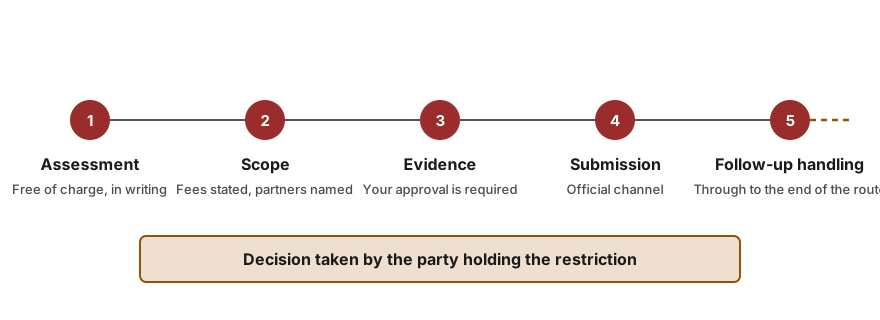
The procedure for a case
- Free initial assessment
You describe what was blocked and provide the notices. We state in writing whether we can assist, what the probable trigger is and which materials we would require from you.
- Scope and fee in writing
Should we proceed, you receive in writing the scope, the fee model and the independent specialists involved before any payment is made.
- Gather the evidence
Your documents are sent through a secure channel. Before anything leaves your hands, we review the file for missing items, dates that do not align and internal contradictions.
- Lodging the appeal
The appeal is lodged through the official channel of the provider. You receive a copy and a ticket reference, so each later message can be linked back to that submission.
- Follow-up handling
We monitor the response, assist with any follow-up questions and state plainly once the matter has reached the limit of what further submissions can achieve.
What to prepare
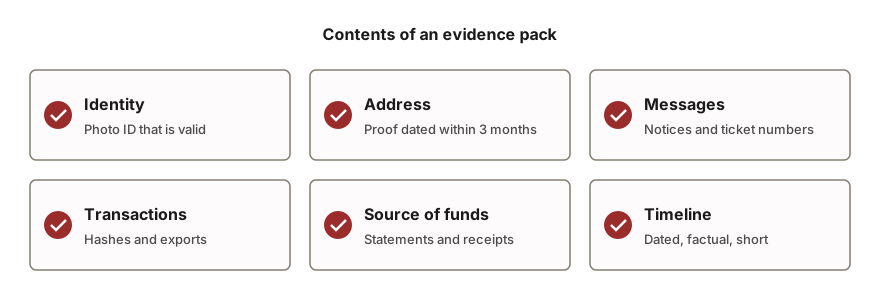
- Government-issued photo identification together with proof of address
- Card or account statements covering the period prior to the block
- Exchange records that document the purchase and the subsequent withdrawal used to fund the account.
- Bank statements establishing the source of the original funds
- The notices, emails and ticket references issued by the provider
- For business clients: include your agreements, billing records, return terms, and a documented history of recent chargebacks.
- Evidence that the wallet or exchange account which sent the funds is under your control
- A brief written account of how and when the funds were acquired, in chronological order
What our work involves
- Review the notice and identify the trigger
We review the emails, in-app messages and terms you were given. Providers usually state only a category. We match that category against your recent transfers, top-ups and activity to find the rule most likely to have fired.
- Classify the reason: risk policy, disputed transactions, or account type
A query about your source of funds, a chargeback ratio and a high-risk category label each call for a separate response. We identify which applies to your case, so your detailed explanation is not sent in reply to the wrong question.
- Compile the document pack
We assist you in gathering bank statements, exchange exports, invoices, contracts and proof that you own the wallets involved, then arrange everything into a single consistent pack a reviewer can verify without delay.
- Write the appeal under the provider's own terms
We prepare a brief, factual appeal that cites the reference of the block, responds to every point raised and attaches the supporting evidence. For businesses, we also address refund policy, dispute handling and descriptors.
- Escalate once the first channel stops moving
Where the standard channel produces no progress, we help you pursue the provider's formal complaint procedure, a regulator or ombudsman if one exists in your jurisdiction, and an independent lawyer when the sum warrants it.
What falls outside our role
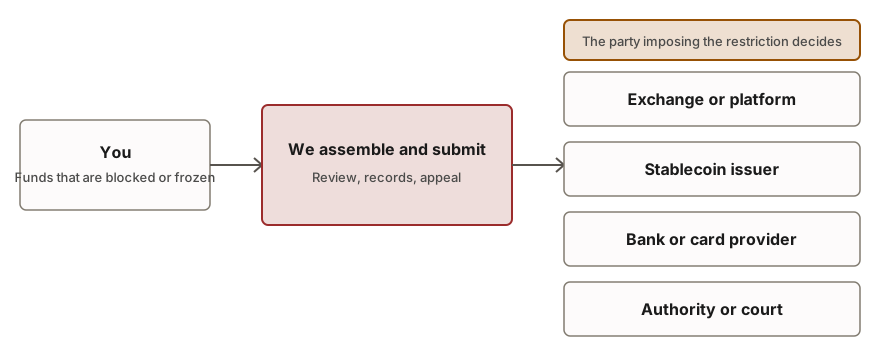
- No one at CryptoAppeals can compel a bank, card issuer or processor to reopen an account or release funds. The provider decides, under its own terms and the law that governs it.
- We do not promise any outcome or any timeline, and we do not accept a submission when we see no realistic route for it.
- Assistance will not be given to alter, backdate or fabricate a document, or to conceal the true source of funds.
- Your seed phrase, private keys, card PIN and passwords are never requested.
Expected timeframes
Provider reviews may take days or several weeks, and certain processors hold funds for a fixed period regardless of any appeal. An estimate follows the assessment and is updated as the case proceeds.
Fees
The assessment carries no fee. After it, you receive a written scope and fee model suited to your case type. No fee is requested before we have told you whether assistance is possible. Fees →
Frequently raised questions
What causes a crypto card or bank account to be blocked?
Frequent triggers include an unclear source of funds, a rapid or large transfer from an exchange, a match with a high-risk category, or a pattern of chargebacks. The notice usually states only a category, so you must determine the actual cause by reviewing your recent transactions.
Is a chargeback issue handled differently from a source of funds issue?
Yes. A chargeback issue concerns the number of customers disputing payments, and the remedy is improved dispute handling together with clear refund terms. A source of funds issue concerns where money originated, and the remedy is documentation. Confusing the two weakens the appeal.
Can I recover my balance once the account has been closed?
As a rule, a provider is required to explain how any remaining balance will be returned, although timing and conditions depend on the jurisdiction and the terms you accepted. Request the closure reason and the release procedure in writing, keep the response on record, and we can assist you in framing that request.
Is it advisable to open another account with the same provider?
In most cases, no. A second account can be interpreted as an attempt to circumvent the block, and it may also be closed. Complete the appeal on the existing account first, and keep every step documented in writing.
Does a payment processor dispute require a lawyer?
Not usually at the beginning. A lawyer becomes necessary if the processor is holding a substantial balance, fails to respond to the appeal, or if a contract term is being disputed. Independent licensed lawyers conduct legal steps, and we will tell you when that stage is reached.
What can I do if the provider refuses to state why it blocked me?
Certain providers may decline to share details, or they may not be permitted to do so. In practice you can still move the matter forward: respond to the questions a reviewer is likely to raise, submit a clean source of funds pack in writing, and request a named contact. As a rule, a complete submission gives a stalled review a clearer basis to proceed.
Common situations
- Card declined at every merchant after a top-up from a crypto exchange
- Bank account restricted following a large transfer received from a crypto platform
- Payment processor holds your balance during an extended review period
- Merchant account closed after the business was placed in a high-risk category
- A sharp rise in chargebacks triggers a reserve or a termination notice
- Neobank sets a source-of-funds deadline and then restricts the account
- Account closed with notice that your activity type is no longer served
Related situations
- Source of funds and wealth documentation packs. Build a clear source of funds and source of wealth pack for exchanges, banks and processors.
- Diagnosing who froze your crypto. Establish who froze your funds and which next step is realistic.
- Help with closing your account and the offboarding process. Closed account or offboarding notice, funds still inside: written requests and escalation.
- Filing complaints with a regulator or an ombudsman. Draft a structured complaint to the regulator, ombudsman or consumer body, with a clear chronology.
Read next
The content on this page is general in nature and is not legal advice.