
Ledger device lost or stolen, or the PIN is forgotten: what the official procedure pages state
Published: Official pages last read: Editorial standards
The manufacturer's own documentation states that crypto is not held on the device itself, so a lost or stolen Ledger does not mean your funds are gone. Access, however, depends on your secret recovery phrase. As a rule, a thief would need the PIN, and the device wipes after three incorrect attempts. In practice, if both the PIN and the phrase are gone, the documentation says the crypto becomes inaccessible. Never enter the phrase into any application or website.
We operate independently of Ledger and have no affiliation with it. We have no ability to affect its decisions, and nothing on this page constitutes an official statement of Ledger.
Any question on your case may be put to us here:
Review of the exchange's own published terms
- As stated in a Ledger academy article, the device does not store your cryptocurrency. It only contains the private keys that manage your funds on the blockchain. Consequently, losing the device does not cause the funds to disappear. [1]
- Material asserts that regaining account access subsequent to device loss necessitates the recovery of your secret phrase. This recovery phrase permits account retrieval across different wallets, devices, and providers, and is designated as the master key to your accounts. [1]
- According to the article, a stolen device is unusable without its PIN, and after three incorrect PIN attempts the device wipes itself. [1]
- The PIN page states that each device is protected by a 4 to 8 digit PIN, that a PIN is required to sign a transaction or update the firmware, and that whoever holds both your PIN and the device can act on your crypto as they wish. [2]
- The documentation suggests treating the PIN similarly to a recovery phrase. Users should select a complex code, observing that 8 digit codes are regarded as the most resistant to guessing. [2]
- On its safety page, Ledger states that a forgotten PIN can be worked around with the recovery phrase, and that access can also be regained when the phrase is lost but the device and the PIN are still available. [3]
- The safety page specifies that when both the PIN and the recovery phrase are lost, the associated cryptocurrency will become inaccessible to the user. [3]
- Ledger instructs users to never input their 24-word recovery phrase onto any device other than a genuine hardware wallet. Only obtain the Ledger Live application from ledger.com because phishing schemes are prevalent. [3]
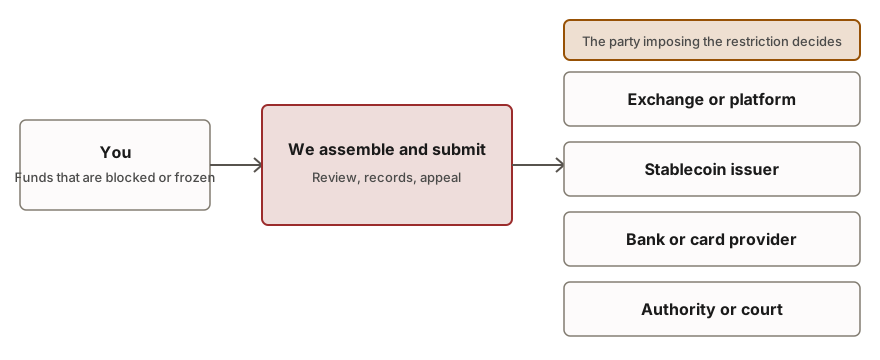
Common Regulatory Restrictions
| Type of restriction | What it means |
|---|---|
| Lost or Compromised Device | According to Ledger's own pages, the funds remain on the blockchain and a thief would still need the PIN. The secret recovery phrase, not the device, is the record that gives you access again. |
| PIN no longer known | The safety documentation notes that the recovery phrase may restore access if the PIN is forgotten. Continuous incorrect PIN entries will result in the device initiating a self-wipe. |
| Missing Recovery Phrase | If the phrase is lost but you still hold the device and know the PIN, Ledger's safety page states that access can be restored. When both the phrase and the device are gone, that page says the funds can no longer be reached. |
| Fake app or phishing attempt | Ledger cautions that counterfeit Ledger Live applications and browser extensions are frequently used for fraud. The recovery phrase should be entered only on a genuine device, and nowhere else. |
Procedure for Required Actions
- Refrain from submitting the phrase to any unauthorized location.
According to Ledger's own documentation, your funds live on the blockchain rather than inside the device. Do not enter your recovery phrase into any app, website or message, no matter what reason is offered.
- Check if you still hold the phrase
You must locate the written recovery phrase which you stored outside of connected electronics. This item facilitates access to your accounts should the device become lost, stolen, or erased.
- Restore solely on a genuine hardware wallet
Ledger instructs users to enter the phrase solely into a genuine hardware wallet, and only when required. Obtain a new or reset device from a reliable vendor and adhere to that vendor's written instructions.
- Download the app solely from ledger.com
Beware that simulated Ledger Live applications are a frequent type of fraudulent activity. All software must be downloaded from the official website; you should also exercise caution regarding unofficial listings or extensions.
- Do not keep trying codes
The documentation states that the device erases itself after three failed attempts. If the PIN does not come back to you, prepare to restore from the recovery phrase rather than submitting further guesses.
- Report the theft and monitor the accounts
Where a device has been stolen, file a report. The PIN offers protection, yet moving funds into a new wallet generated from a fresh recovery phrase is worth considering, and the addresses should be watched.
What to prepare
- The device model and the approximate setup date
- Your recovery phrase, stored offline and entered solely on a genuine hardware wallet
- The addresses and balances verifiable on a block explorer
- Photographs of the screen showing each error message or unexpected prompt
- A record of where and how the phrase and PIN were kept
- A police report number where the device was stolen
Potential Hazards and Fraud Prevention
- Never share your recovery phrase, private keys, PIN or passwords with any person, including callers claiming to represent Ledger or a recovery service.
- Anyone requesting the phrase in order to restore or recover your wallet is seeking your funds. A legitimate restore takes place on a hardware wallet, never on a website or in a chat.
- Counterfeit Ledger Live applications, browser extensions and email messages are a frequent scam. Rely only on the official website.
- Treat unsolicited paid offers to recover a lost device or phrase as untrustworthy.
Circumstances Requiring External Counsel
- You have misplaced both the PIN and the recovery phrase and wish to establish whether any route remains
- A device is damaged and you require a dependable specialist rather than an advertisement
- Funds were taken after you entered your phrase on a counterfeit site and the evidence must be organised
- You are handling the wallet of a person who has died or who cannot act
Frequently raised questions
If I misplace my Ledger, what becomes of my crypto?
According to Ledger's academy article, the crypto is not held on the device itself, so losing the device does not remove your funds. Regaining access requires your secret recovery phrase, which can restore accounts with any wallet, device and provider.
Can a stolen Ledger be used by someone else?
According to Ledger's published pages, a thief is unable to operate the device without the PIN, and the device erases itself once three incorrect PIN entries are made. The same pages caution that a person holding both the device and your PIN can transact, so the PIN must stay private.
What happens if my Ledger PIN slips my mind?
On its safety page, Ledger states that the recovery phrase can restore access when the PIN has been forgotten. Since repeated incorrect entries erase the device, you should stop attempting guesses and instead restore from the phrase on a genuine hardware wallet.
What should I do if I have lost my recovery phrase?
Ledger's safety page explains that access can still be regained if you hold the device and know the PIN, but that losing both the PIN and the phrase leaves the crypto unreachable. The pages we reviewed describe no procedure by which the vendor can reconstruct a phrase that has been lost.
Should I trust a message that claims it can restore my Ledger wallet?
Treat such a message as a scam. Ledger instructs users never to enter the recovery phrase into any application and to rely only on the official website. Unsolicited recovery offers that request payment or secrets follow a common scam pattern.
Does Ledger offer a recovery service?
Ledger markets an optional service under the name Ledger Recover, although we did not review its terms in preparing this page. Before depending on any service that handles your recovery phrase, read Ledger's own description and the applicable terms.
Is this page published by Ledger?
No. We operate independently of Ledger and have no affiliation with the company. This page summarises material from Ledger's own academy pages and links to them, and we have no ability to influence any decision the company makes.
Related services
- Hardware Wallet Recovery Assistance. Lost PIN or lost hardware wallet: clear options and vetted independent laboratories.
- Recovering a wallet password or file. Forgotten password or damaged wallet file: screened independent specialists attempt recovery.
- Help with crypto inheritance and lost account access. Lawful routes to recover a deceased or incapacitated person's crypto, via lawyers and specialists.
Read next
Official pages read
Authoritative and official pages on which this page relies. Such pages are updated, so confirm the current wording at the source itself.
- Lost and Stolen Ledger Devices: Is My Crypto Safe? · Ledger Academy
- Ledger PIN Code: What You Need To Know · Ledger Academy
- Keep My Crypto Safe: 6 Essential Rules · Ledger Academy
The content on this page is general in nature and is not legal advice.