
Recognizing a crypto recovery scam, and testing any provider, ourselves included
Published: Last reviewed: Editorial standards
Fraudulent recovery services tend to share the same features. They make first contact, demand a fee in advance, promise a result, request a seed phrase or remote access, hide behind a vague company, or cite a law firm or agency link that cannot be verified. A genuine provider sets out its scope in writing, names a legal entity, works through independent lawyers and promises no outcome.
Any question on your case may be put to us here:
Why recovery scams succeed
A person who has lost crypto is usually anxious, embarrassed and hopeful, and scammers rely on this. Some purchase lists of victims, while others monitor social media posts, forum threads and public complaints and make contact within hours.
The pitch is always that a fix is now available. The price is a fee, your personal data or access to your wallet. This page is intended to help you examine any provider calmly, whoever it may be.
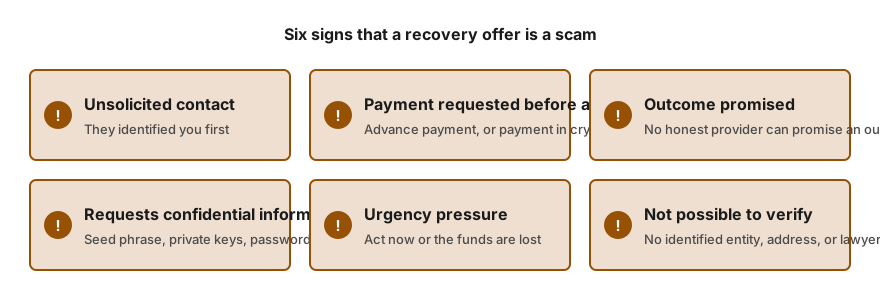
Eight warning signs
A single sign may have an innocent explanation. When several appear together, stop and withdraw from the exchange of messages.
- Unsolicited contact: a message reaches you first on social media, a messenger or by e-mail, frequently after you wrote publicly about the loss.
- Advance fees: payment is requested, often in crypto, before anyone says whether help is possible, or further fees are demanded to release funds.
- Promised results: the language speaks of certain recovery, a share of cases won or a fixed deadline.
- Seed phrase or remote access: you are asked for a seed phrase, private key or password, or invited to a screen sharing session.
- Identity that resists checking: the company is unnamed, no registration number or confirmable address is given, or the website is only a few weeks old.
- Borrowed standing: the sender presents as a government agency, police unit, exchange staff member or law firm, yet gives no route for confirming that claim.
- Insider claims: the sender says it can hack the scammer, bribe an exchange or apply a special tool.
The scripts used most often
In the first script, your own funds are supposedly recovered. A caller reports that the lost funds have been located at an exchange and that a tax, a fee or a verification payment will release them. No such funds exist, and the payment itself is the theft.
The second script uses a false law firm or agency. A professional looking website with an official sounding name offers to take the case. Once you pay, contact stops or new fees appear. Any legal claim should be checked with the relevant bar or registry directly, never through links supplied by the sender.
How any provider can be tested
Put the questions below and expect clear written answers. An honest provider will not take offense. Evasion, pressure or silence is itself the answer.
Every provider is covered by these checks, and that includes us. Please use them on our service as well.
- Request the full legal name, registration number and address of the company, and confirm them in the official register.
- Request a written scope stating what will be done, by whom, what you will receive and what falls outside it.
- Find out the identities of the lawyers and analysts, and whether each is an independent, licensed professional you may approach directly.
- Ask when and how charges arise. A fair provider says whether it can help before it accepts any money.
- Ask what the provider will not do. A serious reply names limits and promises no result.
- Look up the company name alongside terms like scam or complaint, and weigh what appears carefully.
Our role and its boundaries
Our role is to coordinate cases: assessment, preparation of evidence, drafting and escalation. Independent licensed lawyers carry out the legal work, and independent specialists the technical analysis. No exchange, issuer or court can be compelled by us to act.
The first assessment is free. Where we can assist, the fee model is quoted in writing after the assessment and never before it. We never request a seed phrase, private key, password or remote access, and we promise no result. A message in our name asking for any of these did not come from us.
Where you have already paid or granted access
Act promptly but without panic. Make no further payment. If access was shared, move remaining assets to a new wallet from a clean device. Change your passwords, and keep every message, address and receipt.
Report the provider to the police, to your bank if money passed through it, and to the platform on which the contact was made. Do not pay anyone to retrieve your money from a scammer. For a second opinion on a provider about whom you are unsure, you may send us the details for a free check.
Frequently asked questions
Is payment in advance ever normal for a recovery service?
Proceed with care. Honest providers may charge for defined work, such as a report or a legal letter, and they state what you receive. A fee for unlocking or releasing funds, requested before any assessment, is a classic sign of a scam.
Is any legitimate service permitted to promise that my crypto will come back?
No. The outcome rests with others, namely exchanges, issuers, courts and police. Any provider that promises one is misinformed or dishonest. A defined scope, a described process and stated limits are what to look for.
How do I verify a law firm that has approached me?
Do not rely on the contact details sent to you. Locate the bar association or legal register of the country the firm names, search there for the firm and the lawyer, and telephone the number you find in that source.
What should I make of a service with a special tracing tool?
Tracing tools do exist, and independent analysts use them to prepare reports. A tool cannot return funds by itself, however. Ask what the output is, who signs it and how it would be used with an exchange or authority.
I believe I was scammed a second time. What follows?
Make no further payment and secure your accounts. Keep every record, then report both incidents to the police and to your bank. A repeat scam is common and carries no shame. Hand the whole timeline to any adviser you consult.
How we can help
- Tracing stolen crypto and freeze requests. Tracing of stolen crypto, with freeze requests to exchanges and issuers and a police filing.
- Report on blockchain transaction analysis. A source-of-funds report based on transaction tracing, prepared in a form a compliance team can review.
- Diagnosing who froze your crypto. Establish who froze your funds and which next step is realistic.
- Filing complaints with a regulator or an ombudsman. Draft a structured complaint to the regulator, ombudsman or consumer body, with a clear chronology.
The content on this page is general in nature and is not legal advice.