
Filing a complaint with a financial regulator or ombudsman about a crypto platform: preparation
Published: Last reviewed: Editorial standards
Filing a complaint with a financial regulator or an ombudsman can place formal pressure on a platform that has stopped responding, but only where such a body exists and the platform sits within its remit. This depends on your jurisdiction and on the platform's licence status. An effective submission is brief, dated and supported by evidence. We help you identify the available routes, build the chronology and prepare the filing. We cannot make a regulator act.
Any question on your case may be put to us here:
Who this service is meant for
- The platform no longer responds, and its internal complaint procedure has run its course
- You need to find out whether a regulator or an ombudsman has authority over the platform in your country
- You submitted a complaint to a regulatory authority and received only a standard response that contained no specific action taken.
- Prepare a clear timeline and evidence pack before you file the complaint
The procedure for a case
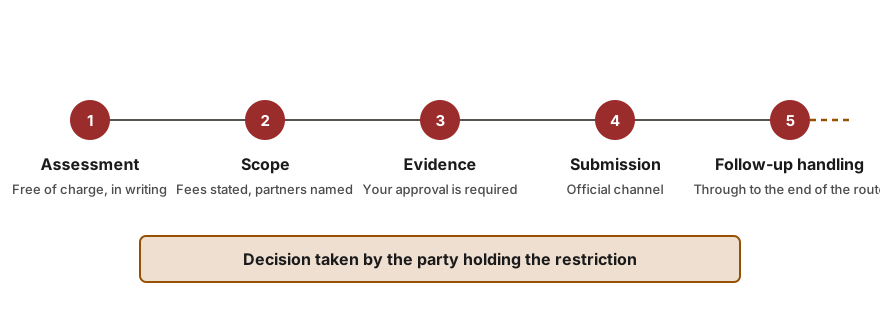
- Free initial assessment
Send a brief summary together with the name of the platform. We confirm in writing which complaint routes appear available, how well the file stands up, and whether our assistance is possible.
- Set the scope
You receive a written scope and fee structure covering the preparation work, and the independent lawyer if one is involved. Declining carries no cost to you.
- Gather and arrange evidence
Documents are uploaded by you through a secure channel. We then construct the chronology and mark any gaps or inconsistencies in dates and amounts before any submission is made.
- Submit the complaint
You check the finished text before submission. The complaint goes through the official form or address of the body, and you retain the confirmation together with the reference number.
- Monitor and reply
We assist you in responding to requests from the case handler and explain what each reply means. If the body declines the case or cannot assist, we say so plainly.
What to prepare
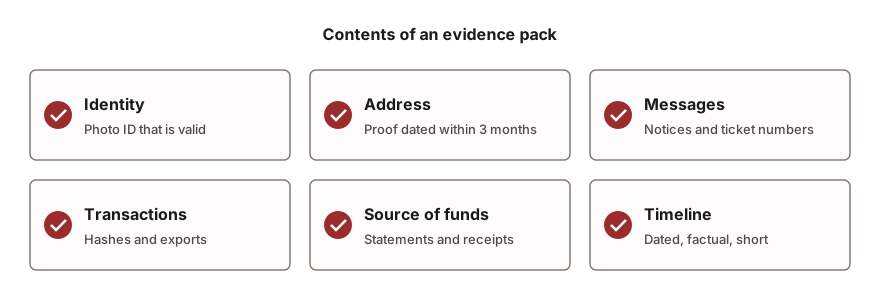
- The official title of the exchange, its documented corporate location, and any legal authorization number publicly provided.
- Your account identifiers and the transaction history covering the relevant period
- Copies of every complaint you sent to the platform, along with its replies
- The terms of service and fee schedule in force at the time
- Images showing the on-screen warnings, alerts or limitations you received
- Government-issued photo identification together with proof of address
- Bank or card statements where a payment provider forms part of the dispute
What our work involves
- Identify the routes available for your case
Our review covers your place of residence, the platform's place of operation, and the licence it claims publicly. On that basis we set out the possible bodies: a financial regulator, an ombudsman, a consumer agency, or a payment scheme dispute procedure.
- Compile the chronology
Your messages, tickets and screenshots are converted into a dated, numbered timeline. Every event is linked to a specific piece of evidence, so a case handler can follow the sequence without asking you to explain it again.
- Assemble the evidence pack
Our team arranges your statements, notices, terms of service and evidence of the complaint you made to the platform into one record. Duplicates and unrelated items are removed, so the submission remains centred on the relevant facts.
- Prepare the complaint
We prepare a concise, factual complaint setting out the problem, the loss, the steps you have already taken and the outcome you seek. Claims we cannot support are left out, and the format required by the authority is followed.
- Engage a lawyer where required
Where your matter calls for formal legal steps, such as a claim or a notice before action, we refer you to an independent licensed lawyer. That lawyer acts for you under a separate engagement of their own.
What falls outside our role
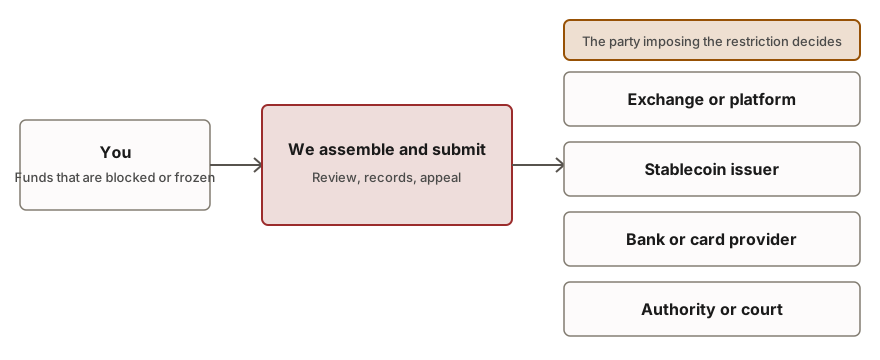
- No submission from us compels a regulator, an ombudsman or a platform to act, or to rule in your favour. Each decides under its own rules and powers.
- No one can be guaranteed a result if the platform is not covered by any applicable complaint body in your jurisdiction.
- We never threaten a platform or publish accusations that our evidence cannot support.
- We will never request your seed phrase, private keys or account passwords.
Expected timeframes
Regulators and ombudsmen vary considerably in how quickly they respond, and some need months to reply. Once your documents are assembled, preparation of the complaint typically takes days. We provide an estimate after the assessment and revise it as the body responds.
Fees
The assessment carries no charge. Following it, you receive a written scope and a fee model covering the preparation work. We ask for no fee before we have informed you whether we can assist. Fees →
Frequently raised questions
Can I file a complaint against a crypto exchange with a regulator?
In some situations, yes. This depends on your country and on whether the exchange holds a licence or registration there. Certain regulators accept complaints only concerning firms they supervise, while others refer consumer matters to a separate body. Availability differs by jurisdiction.
Who is a financial ombudsman and does its authority extend to crypto?
An ombudsman is an independent body that resolves disputes between customers and financial firms. Whether its remit extends to crypto platforms depends on the country concerned and on the licence status of the platform. Some fall within it, many do not.
Does the licence status of the platform make a difference?
It can. A platform licensed in your jurisdiction is, as a rule, answerable to a regulator or an ombudsman there. A platform that is unlicensed or located offshore frequently falls outside those routes, and this narrows the options open to you.
What does a complaint need in order to be effective?
In practice, structure matters. Describe the problem in a few sentences, include a dated chronology, attach evidence for every step and state precisely what outcome you are requesting. Emotional passages and accusations without support make it easier for the recipient to set a complaint aside.
Is it necessary to raise a complaint with the platform itself first?
As a rule, yes. Many regulators and ombudsmen expect you to have completed the platform's internal complaint procedure before contacting them, and they may request proof that you did so. Keep every message you send and the final reply you receive, and keep a record if no reply comes.
Can a regulator recover my funds for me?
In most cases, not directly. A regulator may open an investigation into the firm or press it to respond, and an ombudsman may issue a binding decision, yet neither can promise the return of funds. We make no promise about any outcome either.
Common situations
- Exchange account frozen for months with no written explanation of the basis
- Platform disregarded multiple formal complaints submitted through its own support channel
- Withdrawal declined after account closure, with no appeal route provided
- It remains uncertain whether the platform is licensed to operate in your country
- Marketing statements or fee adjustments that were misleading and affected your funds
- A card or payment provider tied to a crypto service declined your chargeback or dispute
Related situations
- Unblocking an exchange account. Understand the restriction, prepare KYC and AML evidence, reply and appeal.
- Help with closing your account and the offboarding process. Closed account or offboarding notice, funds still inside: written requests and escalation.
- Blocks on crypto cards and payment accounts. Card, neobank or processor account blocked: identify the trigger, document it, appeal.
- Support when P2P trade funds are frozen. Funds locked after a P2P sale? Record the transaction and file a formal appeal with the bank or exchange.
Read next
The content on this page is general in nature and is not legal advice.