
Drafting an appeal to a crypto exchange: format, wording and supporting documents
Published: Last reviewed: Editorial standards
A strong appeal stays short, factual and complete. It identifies you and the affected account, states the restriction and its date, responds precisely to the question the exchange posed, and documents the origin of the funds. It closes with a single, clear request. Submit it once via the official channel, retain the reference number, and omit anger, threats and speculation.
Any question on your case may be put to us here:
First, establish what the exchange is actually requesting
A message about a restriction does not always invite an appeal. Some notices request documents. Others simply record a decision. Read the notice twice and determine which type you have received, because each calls for a different response.
When the notice poses a question, respond to that question alone. When it records a decision you believe is mistaken, prepare an appeal. If the platform supplies its own form with fixed fields, complete that form, and apply the structure below only to any free-text box.
Certain exchanges state openly that they may not disclose the exact basis for a restriction. Kraken's help page does so. In such a case, do not speculate about the reason. Instead, ask what information is required to finish the review. Begin by recording the exact wording of the request in your notes.
A general skeleton you can adjust
Follow one fixed order in every submission. A reviewer processes many files, and a structure they recognise lets them locate your facts, your records and your request within seconds. The skeleton below is generic. Replace each description with your own facts, and include nothing you cannot support with evidence.
Our appeal letter builder, a free tool at /tools/appeal-letter/, places the details you enter into this sequence. It operates in your browser, keeps no data and inserts nothing beyond what you typed. You may copy the letter or download it as text. The skeleton can also be followed manually.
| Section | What to write |
|---|---|
| Subject line | State the purpose, and include your case reference if one exists, for example: request for review of an account restriction. |
| Who you are | Your full name exactly as it appears on the account, plus the account email or ID if the platform assigns one. |
| The restriction | Scope of the restriction (login, withdrawals, trading, or the entire account), together with the date on which it started. |
| What notice you received | The exchange's communication, restated in your own words, including its date and any reference number. Quote the text only when you can reproduce it word for word. |
| Source of the funds | State the origin in plain terms, for example wages, the sale of an asset or earlier trading, and list the documents by name that evidence it. |
| Attachments | List every file by name and state which question it answers. |
| The request you make | One specific request, for example: review the restriction, or state precisely which information is missing and by what date. |
| Close | Include a specific request for the case reference and the subsequent steps, your name, and a contact method that the platform already possesses. |
Maintaining a Tone of Calm, Precision, and Brevity
Prepare the submission for a reviewer whose attention is solely focused on your file. Concise sentences, specific dates, and financial amounts are preferred.
Write the first letter in a neutral tone. Complaints about the exchange, threats of legal action and accounts of your feelings do not assist the reviewer, and they obscure your facts. Should you escalate later, you keep a clean record showing you responded in full. Read the draft once and remove every sentence that is neither a fact nor a request.
- Formulate only one distinct request per formal submission to the review board. The reviewer processes one clearly defined requirement with greater efficiency.
- Employ common language that mirrors the terminology utilized by the platform in its support documentation.
- Document all relevant dates in full format, for instance 12 October 2026, and clearly state all monetary amounts along with their currency.
- Lead with the facts and state your request after them. Leave opinions about their decision out.
- Avoid speculation concerning the motivation for the exchange's action, and refrain from addressing the platform's operational staff.
- Maintain a courteous demeanor regardless of your current state of frustration with the process. A respectful communication makes the subsequent response easier to process.
Documents to include
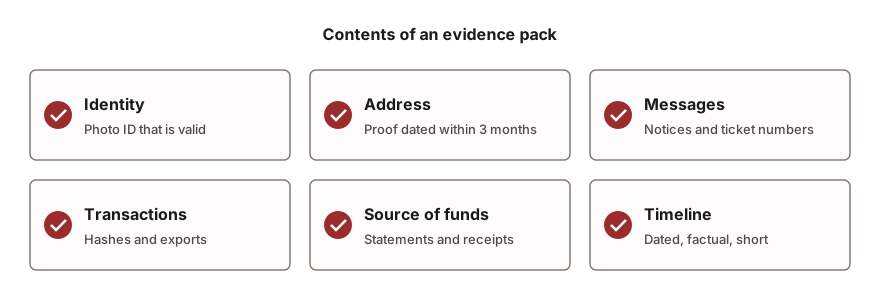
Include only material that answers the question raised in the notice, and nothing beyond that. Each document must justify its inclusion, and the letter should state what each one demonstrates. Kraken's help page, as an example, asks customers to submit clear, current documents and to address every question in a single response, since incomplete replies can add days to the procedure. Gather these records before you begin drafting.
- Government-issued photo identification matching the account holder's name, plus proof of address where the notice requests it.
- The exchange's original message, or a screenshot of the restriction that displays its date.
- Bank statements or receipts recording funds sent from you to the exchange, or paid out by the exchange to you.
- Exports of your prior transaction history on the exchange, where the funds arose from trading activity.
- The wallet addresses under your control, together with a note of how you would demonstrate that control if requested.
- A timeline on a single page, running from the initial deposit to the date the restriction took effect.
- A brief cover note itemizing every document and stating which question each one addresses.
What to omit
Omit every detail that adds noise or creates risk. Additional private information does not make a submission stronger, and certain items can weaken it. Before sending anything, review the draft once against this checklist and once against the notice itself.
- Seed phrases, private keys, passwords and one-time codes. An appeal must never contain them, and you should not share them with anyone claiming they can help.
- Records you have altered, retouched or cannot substantiate. In practice, explaining a missing document is simpler than explaining one that has been modified.
- Irrelevant grievances, extended personal narratives, and outdated disagreements.
- Personal data belonging to another person, unless the request requires it and that person has agreed.
- Claims about laws or rights that you have not verified. One incorrect legal assertion can undermine a letter that is otherwise clear.
Once your submission is filed
File the appeal one time only, using the official channel the notice specifies. Keep a record of the exact submission, the date, and any reference number issued to you. Do not send it through a third party who contacted you first, and never pay anyone to forward it.
You should then allow the exchange the review range it stated. Our guide on how long an exchange compliance review takes records what two exchanges state about timing. Once that range has passed, send a single follow-up in the same thread. If the response is negative, request the specific basis for the refusal and check whether the platform offers a second review.
When documents are repeatedly refused, when the sum at stake is large, or when a complaint to a regulator is possible, additional assistance may justify its cost. The initial assessment with us costs nothing, and before any fee is discussed we state in writing whether we are able to assist. We have no power to compel the exchange to rule in your favour, and we never request a seed phrase, private key or password. If you want a second pair of eyes on your draft, request the assessment.
Frequently asked questions
Is it better to submit a single lengthy appeal rather than several short messages?
Prepare a single, complete submission. One letter containing every relevant attachment presents the reviewer with the full record at once. Splitting the facts across several partial messages tends to disperse the basis of your case, and in practice it can leave the reviewer uncertain about which version of the account of events is the current one.
Does the accepted procedure permit the use of pre-existing templates or automated systems when constructing your appeal?
A template can supply the structure. Every fact must remain yours, and you must be able to support each one with a document. Do not let any tool invent dates, amounts or reasons you did not provide. Never paste a seed phrase, private key or password into any tool.
What if my appeal is rejected?
Ask for the precise reason and for whatever information is missing. Check whether the platform offers a second review. Compare the response with your own documents and close any gap. Where a platform is regulated and such a route exists, a complaint to the regulator or ombudsman may be possible.
Is it wise to name a lawyer or an authority in your initial appeal to the exchange?
Only where one is already engaged. A first appeal should set out the facts calmly and state a clear request. Naming a lawyer or regulator you have not retained can read as pressure and adds no evidence.
Is payment to another person for drafting the appeal required?
No. Writing the submission yourself is permitted, and many account holders do exactly that. Paid assistance becomes reasonable when the facts are complicated or the sum involved is substantial. Before you accept any arrangement, request the scope of work and the fee in writing. An offer that arrives without you asking for it should be treated as a warning sign.
How we can help
- Unblocking an exchange account. Understand the restriction, prepare KYC and AML evidence, reply and appeal.
- Source of funds and wealth documentation packs. Build a clear source of funds and source of wealth pack for exchanges, banks and processors.
- Diagnosing who froze your crypto. Establish who froze your funds and which next step is realistic.
- Filing complaints with a regulator or an ombudsman. Draft a structured complaint to the regulator, ombudsman or consumer body, with a clear chronology.
Sources
Authoritative and official pages on which this page relies. Such pages are updated, so confirm the current wording at the source itself.
- Why is my account restricted? · Kraken
The content on this page is general in nature and is not legal advice.