
Procedure for Understanding Pig Butchering and Romance Investment Scams
Published: Last reviewed: Editorial standards
Pig butchering procedures establish a relationship foundation prior to requesting financial submissions. These typically initiate on social media platforms or dating applications. Victims purchase digital currency at a legitimate exchange and transmit funds to an unauthorized address. You should cease payments immediately, preserve all records, report the activity to the appropriate authority, and disregard recovery offers requiring fees.
Any question on your case may be put to us here:
Defining the Scheme: Fundamental Terms of Operation
Pig butchering represents a specific term of art for an extended fraudulent operation. The operator first establishes a relational connection before directing communication toward cryptocurrency investments, which encourages continued monetary submission from the participant.
According to the Canadian Anti-Fraud Centre, these protocols frequently begin via contact established on a social networking platform or dating application. Once confidence has been established, the discussion transitions toward the potential for wealth utilizing digital assets. Victims purchase digital currency from a regulated exchange and transfer the resulting funds to an address managed by the perpetrator.
That record holds specific weight. While a verifiable exchange name on your financial record may appear as evidence of a legitimate investment, it merely confirms the purchase of cryptocurrency. After the funds are transmitted to the controlling party, they are generally no longer recoverable, as cryptocurrency transfers lack the protections afforded to standard payment methods.
Examination of the Process Sequence: Sequential Stages of Operation
The circumstances differ from case to case, yet a similar arc recurs often. The table below helps you locate your situation, and the right-hand column lists the signs to watch for at each point.
These stage names were created by us. The underlying pattern is drawn from public alerts issued by consumer protection and law enforcement bodies, and no individual case follows it exactly.
| Stage | What takes place | What to watch for |
|---|---|---|
| First contact | An unknown person messages you through a dating application or social platform, appearing friendly and interested in your life. | A person you have never met shows quick, warm interest in you and within a short time suggests moving to a private messaging application. |
| Building trust | Daily messages arrive, containing photographs, joint plans and discussion of the future. The individual avoids any meeting in person or on a live video call. | Rapid growth of emotional closeness, paired with a recurring explanation for why meeting in person never happens. |
| The pitch to invest | The individual refers to a crypto opportunity, usually a trading application or website that they or a family member claim to use. | A recent acquaintance offers instruction in earning money through crypto and proposes to act as your guide. |
| First deposit and fabricated profits | You purchase crypto and transfer it to an address or platform the individual specifies. The platform displays growing profits. | The balance exists solely on a web page or application controlled by the scammer's side. |
| Larger deposits | The individual presses you to contribute more, at times drawing on savings, a loan or a pension. | Pressure to act quickly, together with discouragement from discussing matters with your bank, family or friends. |
| Withdrawal blocked | A withdrawal does not go through, or you are asked to pay a fee, tax or deposit first. | A demand for payment before your own funds are released, followed by a fresh reason for another payment each time. |
| Recovery pitch | Once the loss has occurred, a stranger writes to you, promising recovery of the funds in exchange for a fee. | Yet another unknown party, yet another fee. The Canadian Anti-Fraud Centre describes such offers as a further layer of the same fraud. |
Warning signs to review today
Any single sign may still have an innocent explanation. When several appear together, that is grounds to pause, stop sending money and speak with someone you trust. If two or more of the signs below match your situation, continue directly to the next section.
- You met this person online and have never met them in person, yet conversations about money or crypto have already begun.
- They direct you toward one specific trading app or website, and no independent information about it can be found.
- This platform demonstrates considerable profits swiftly while facilitating deposits but complicating the withdrawal process.
- A request is made for you to submit a payment of a fee, tax, or deposit before accessing your existing balance.
- Scammers might require you to transmit crypto to a designated address, or they could demand assets citing a government entity, which the Canadian Anti-Fraud Centre identifies as a scam indicator.
- These parties actively seek to dissuade you from consulting your bank, your family members, or a licensed financial advisor.
- Scammers often pressure you to execute actions rapidly or obtain loans specifically to increase investment amounts.
Current Situation: Required Procedural Actions.
It is understood that your situation is not unique, and accountability rests solely with the individual who provided the deception. The following actions represent the initial, composed steps to consider.
Early submission of information is relevant for recovery procedures. The Canadian Anti-Fraud Centre detailed a 2022 instance in Winnipeg involving a $17,000 transfer that was recovered after reports were filed with both the Centre and local police. While this result is not a rule, swift reporting warrants consideration.
- Immediately cease all monetary disbursements, including mandatory fees, taxes, or requested deposits labeled for verification. Do not transfer any sample amounts to test the viability of future withdrawals.
- Avoid engaging with or making threats toward the individual involved in the exchange. Ensure you document every message record before ceasing all subsequent replies.
- Preserve every piece of evidence: wallet addresses, transaction hashes, screenshots of the chats, profiles and the platform, together with your bank and exchange records.
- Contact the exchange you used and your bank, and describe what happened. As a rule, each can act only on funds or payments still within its own control.
- File a report with the police or the national fraud reporting service. Our country-by-country reporting guide lists the official channels in eight countries.
- Protect your accounts first: set new passwords, and uninstall any application or remote-access program the scammer asked you to install.
- Inform a person you trust. Shame keeps many victims quiet, and that silence works in favour of the scammers.
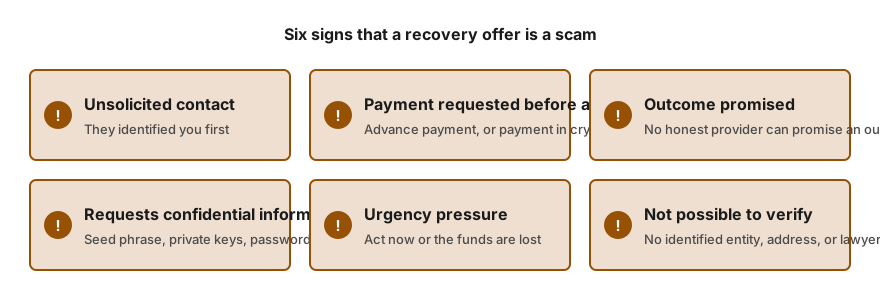
How follow-up recovery fraudsters reach prior victims
If one scam has taken your money, a second attempt often follows. As a rule, people recorded as victims of an earlier loss are contacted soon after, sometimes within days, by someone presenting an offer to recover the funds.
The FBI's IC3 cautions the public about false law firms that state your name appears on a government roster of scam victims and that court proceedings can return your funds. The Canadian Anti-Fraud Centre describes fee-based recovery pitches as an added layer of the same scheme. Kraken's help page on lost crypto states that proposals to retrieve funds are almost always a second scam, frequently demanding payment in advance.
The Federal Trade Commission in the United States gives a plain instruction: refuse anyone who contacts you and offers, for payment, to recover money you lost to a scam. According to IC3, genuine law enforcement agencies do not charge victims.
Verify any lawyer or firm yourself in the official register, without using the details they send you. Do not grant remote access to your device, and never give a seed phrase, private key or password to anyone. The recovery scam check tool on this site asks ten questions and lists the warning signs.
Where to seek help after this
Should you want assistance assembling a record, following the movement of funds or submitting freeze notices to platforms in a position to act, request a free assessment from us. We respond in writing on whether assistance is possible, and no fee is discussed before that point. Tracing and legal work are carried out by independent specialists, and our role is coordination. Whether an exchange, an issuer or the police act is a decision for them, not for us. We will never ask you for a seed phrase, private key or password.
If any doubt remains about whether a scam is underway, send us the particulars for a calm second opinion before you part with any money.
Frequently asked questions
Why is it called pig butchering?
The label is slang for the practice of fattening a victim's trust before the money is taken. Agencies also use the term, often alongside the plainer phrase romance-investment scam. Each describes the same pattern of conduct.
Is it possible to recover money lost to a pig butchering scam?
Occasionally, though rarely, and no one can promise it. Where the funds arrived at an exchange able to freeze them, a prompt and well-documented submission may assist. Where they moved to a private wallet, there may be nothing available to freeze. Reports nonetheless generate records on which banks and authorities rely.
An exchange or platform is demanding a fee or tax payment before releasing my withdrawal. Is this legitimate?
Regard such a demand as a warning sign. When a platform requires fresh payments before releasing your own balance, that balance may never have existed. Do not pay. Keep the message, cease sending money and report the platform.
Does bearing responsibility for the deception fall on me?
No. These schemes are built to earn trust over time, and they reach careful and experienced people as well. As a rule, many victims say nothing because of shame, and that silence is precisely what the fraudsters rely on. Speak to a person you trust, and then follow the practical steps set out in this guide.
If a person asks for an upfront payment before returning my crypto, what is the proper response to that offer?
Verify before you pay anyone. Offers of recovery that arrive unrequested are a familiar second scam. Request the company name and its registration number, and check both records yourself. Report the contact to the platform through which it reached you. Never disclose a seed phrase, private key or password.
How we can help
- Support after a crypto scam. Structured support after a crypto scam: review, documentation, tracing and freeze requests.
- Tracing stolen crypto and freeze requests. Tracing of stolen crypto, with freeze requests to exchanges and issuers and a police filing.
- Preparing digital evidence for crypto cases. Collect and file chats, screenshots and records so they can be used by the authority, the exchange or counsel.
- Report on blockchain transaction analysis. A source-of-funds report based on transaction tracing, prepared in a form a compliance team can review.
Sources
Authoritative and official pages on which this page relies. Such pages are updated, so confirm the current wording at the source itself.
- Investment scams and fraud · Canadian Anti-Fraud Centre
- Crime information: Cryptocurrency · FBI Internet Crime Complaint Center (IC3)
- Worried about crypto exchange losses? Don't pay money for help recovering money · US Federal Trade Commission
- Can I recover crypto lost to a scam? · Kraken
The content on this page is general in nature and is not legal advice.