
Wallet screening risk scores explained: what they are and whether they can be mistaken
Published: Last reviewed: Editorial standards
A wallet screening risk score is a rating assigned by analytics software to a crypto address, based on that address's past links to other addresses and services. Ratings of low, medium and high, often displayed as green, amber and red, show how close the address sits to categories such as scams.
Any question on your case may be put to us here:
What screening does
Wallet or address screening is a procedure that banks, exchanges and payment firms apply to crypto addresses. The software examines the sources from which an address received funds, where it sent them, and which services it touched.
The outcome is a risk score or a label. Businesses rely on it when they decide whether to accept a deposit, hold a withdrawal or request further information from the customer.
What the colours and categories mean
Each provider applies its own scale, so the numbers and names differ and are not standardised. Across most tools, the underlying idea remains the same.
- Green or low: the screening found no clear connection to risky categories, or any connections sit far in the transaction chain.
- Amber or medium: connections exist to categories that call for closer review, for example gambling, selected exchanges or jurisdictions treated as high risk.
- Red or high: a close or direct connection exists to categories such as mixers, scams, ransomware, sanctioned parties or darknet markets.
- Category labels: the tool may state the kind of exposure, for example sanctions, fraud or mixer, and may report how many steps separate it from your address.
- Direct versus indirect exposure: as a rule, a direct connection carries more weight than one positioned several hops away.
How a score can be inaccurate
These tools rely on patterns and probabilities, which means mistakes occur. Indirect exposure is the most frequent issue. Your address took funds from a person who had taken funds from a flagged source, and the score records that remote link even though you had no practical way to detect it.
A further issue is clustering. Software assigns addresses it believes belong to one owner, and at times this assignment is incorrect. Labels may also be outdated, because ownership of a service can change or an address can be reused once the original risk has passed.
Providers may also reach different conclusions for one address. When one tool shows a high score and another shows a low score, that difference is a sound basis to request a closer review.
What follows when a score leads to a block
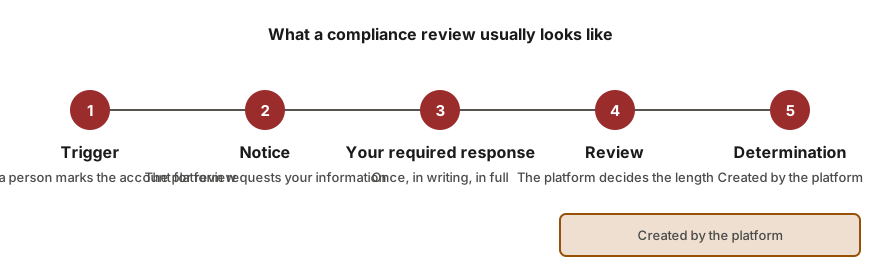
When a company sees a high score, as a rule it may hold the deposit or restrict the account while it reviews. In practice it can request source of funds documents, identity verification, or an explanation of the transaction.
In most cases the company will not cite the score itself as its reason; it usually states only that the account is under review. For that reason, it is often worth asking in writing which transaction or address triggered the alert.
How a score can be contested
As a rule, a challenge carries more weight when it is precise and documented. Identify the address and the transaction at issue, and support a brief explanation with documents.
- Request from the company the address and the transaction that produced the alert.
- Assemble a transaction history documenting how the funds reached you and the purpose they served.
- Attach evidence of the original source, for example records from an exchange, receipts or a bank statement.
- Submit a request that the company review the alert, or that its provider rerun the check.
- Record every response in writing, and make each submission through the official channel.
Places we serve
An assessment of your case is available at no cost, and it begins with a review of the address history. Independent specialists describe what a score tends to reflect and help you prepare a clear challenge. We cannot change a score, and we cannot require any company to accept a challenge. We never ask you to provide a seed phrase, a private key or a password.
Frequently asked questions
Does a red score make my wallet criminal?
No. It indicates that the software detected a connection to a category considered risky. That connection may be indirect or date back years. A reviewer judges whether the link is relevant, and a written explanation supported by documents frequently resolves the question.
Is it possible to look up the score of my own wallet?
A few analytics firms provide limited checks without charge, while others sell reports only to companies. Tools do not always agree, so a single score deserves to be read as an indication rather than a final conclusion.
Can a wallet score ever be taken off?
A provider may revise a label when persuasive evidence is submitted, but no rule obliges it to do so. As a rule, the practical aim is to satisfy the company that holds your funds rather than to change the score itself.
Why did the exchange take my deposit and freeze it afterwards?
Screening often runs again when fresh information reaches the provider. A label can shift after the deposit has been accepted, and that shift can set off a review of the funds already received. At that point the exchange may request documents from you.
How we can help
- Disputing risk flags from wallet screening. High-risk address flag from screening tools: record the funds path and dispute it.
- Report on blockchain transaction analysis. A source-of-funds report based on transaction tracing, prepared in a form a compliance team can review.
- Source of funds and wealth documentation packs. Build a clear source of funds and source of wealth pack for exchanges, banks and processors.
- Diagnosing who froze your crypto. Establish who froze your funds and which next step is realistic.
The content on this page is general in nature and is not legal advice.