
Your wallet or deposit was flagged as high risk: documenting the facts and challenging the flag
Published: Last reviewed: Editorial standards
Screening tools assign wallets a score based on connections to risky services, including mixers, darknet markets and sanctioned entities. A high score may freeze a deposit even though your own conduct was clean, because the link can sit several hops away. A flag can also be incorrect or stale. We help you trace the actual path of your funds, document it and submit a challenge to the exchange. We do not assist in concealing illicit funds.
Any question on your case may be put to us here:
Who this service is meant for
- The exchange refused or held your deposit and referred to a high risk score
- You received crypto from a person or a shop and later learned it had indirect ties to a mixer or darknet
- Your own wallet carries a risk label in a free checking tool and the reason is unclear
- A compliance team asked questions about a counterparty you hardly know
The procedure for a case
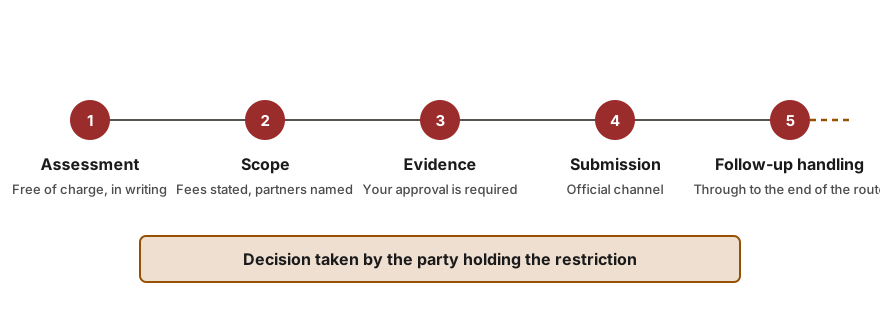
- Free initial assessment
You inform us what was flagged and provide the notice. We respond in writing on whether this appears to be a false positive, indirect exposure or something more difficult, and on whether we can assist.
- Written scope and fee summary
Where the process continues, you receive a scope in writing that names the independent analysts and sets out the fee model. No payment is due until you have read that document and confirmed your acceptance.
- Screening of the transaction
The analysts examine the transactions that were flagged and trace how the funds moved. In return you get a plain-language summary of what the blockchain record shows, and of what it does not.
- Submitting the dispute
The dispute submission, together with its evidence pack, goes to the exchange, and where the vendor is involved, a correction request is sent to that vendor as well. You receive copies and the reference numbers for your record.
- What happens next after the review
We monitor responses, address further questions, and state plainly whether the flag has a sound basis or whether no procedure remains open.
What to prepare
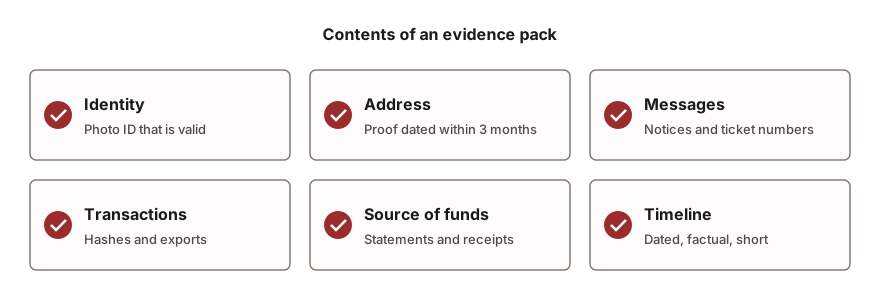
- Notice or email from the exchange referring to the risk flag
- Hashes of the transactions and the wallet addresses involved
- Proof of how the funds were obtained: invoices, receipts, bank transfers or chat records
- Counterparty details, where known, plus any order or contract
- Screenshots of any risk check produced by a third party
- Government-issued ID and proof of address, if requested by the exchange
- A brief written chronology of the transfer and the first alert
What our work involves
- Establish what the flag actually states
As a rule we ask the exchange in writing for the exposure category and the screening vendor, then review how a high score is defined in that tool. Direct links to a risky service carry far more weight than indirect exposure spread across many hops.
- Follow the true transaction path of your funds
Independent analysts trace transactions from your wallet back to origin and forward to the flagged entity. The record shows whether exposure is direct, indirect, small in amount, or unrelated to your own conduct.
- Set out your account in plain written terms
You describe how the funds were obtained, from whom, and for what purpose. We then attach purchase records, chat logs and receipts so that a compliance reviewer has a consistent, dated account to examine.
- Contest the flag with the exchange
We draft a structured dispute that identifies the transactions, sets out why the exposure is indirect or mistaken, and requests a specific review. The tone stays factual, and submission goes through the exchange's official channel.
- Report errors to the analytics vendor
If the data itself appears wrong, for example an outdated label or a misattributed cluster, we assist you in filing a correction request with the screening vendor. As a rule this goes via the exchange or the vendor's own dispute form.
What falls outside our role
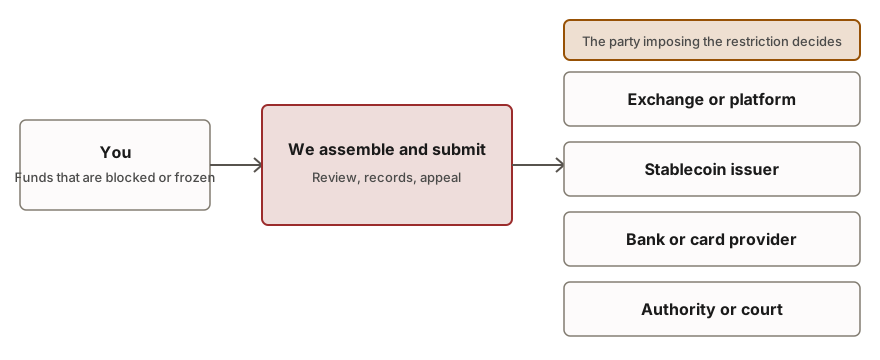
- A screening vendor or an exchange cannot be compelled by us to remove a flag. Each one decides under its own policies and the law that applies to it.
- Our service does not assist with hiding, cleaning or mixing illicit funds, and cases where the funds appear to originate from crime are not accepted.
- Where the screening supports the flag, we tell you that plainly and do not promise any particular outcome.
- As a rule of our procedure, you will never be asked to provide a seed phrase, private keys or an exchange password.
Expected timeframes
How long review and dispute steps take depends on the exchange's compliance queue and on how many transactions must be traced. A brief single-path case moves faster. An estimate follows the assessment in writing and is revised as responses come in.
Fees
The assessment carries no charge. Once it is complete, you receive in writing a scope and a fee model for your case. Before we tell you whether we can assist, no fee is requested. Fees →
Frequently raised questions
What is the meaning of a high-risk wallet flag?
It means a screening tool has recorded a connection between the address and a category such as a mixer, a darknet market or a sanctioned entity. That connection may be direct or sit several hops away. It functions as a signal for review, not as evidence that you did anything wrong.
Can a flag be a false positive?
Yes. Labels age, cluster attribution can be wrong, and minor indirect exposure may raise a score unnecessarily. For that reason, a review at the transaction level is worthwhile. We cannot promise that the tool or the exchange will accept our position, but we can present the underlying facts in a clear written submission.
Is it possible for you to take the flag off my wallet?
The flag is set by the vendor and the exchange, not by us. As a rule, we can compile a written explanation of why the flag may be incorrect and then file a formal correction or dispute through the appropriate channel. This procedure requires you to provide the relevant records and documentation in writing.
Will you assist me if the funds truly originated from a darknet market or a mixer?
No. We do not take part in hiding or laundering illicit funds. If the review establishes a genuine connection to such a source, we will say so plainly and in writing. We may still assist you in responding truthfully to a lawful compliance request, and where legal questions arise, an independent lawyer is the party qualified to advise you.
What actions should I avoid once my deposit has been flagged?
Do not route the funds through other wallets or services in order to avoid the review. As a rule, this can be read as evasion and will make your position worse. Keep the funds where they sit, preserve every record, and answer the questions the exchange asks truthfully and in writing.
Is a free risk checker sufficient to demonstrate that my wallet is clean?
No. Free checkers rely on data and scoring methods that differ from the tool your exchange uses. A clean result from such a service does not override the exchange's own assessment. It can nevertheless serve as one additional piece of evidence when you submit a dispute.
Common situations
- Deposit credited and then withheld following an address screening alert
- A transfer that came from a peer-to-peer transaction where the sending wallet was linked to a mixing service several years earlier.
- Wallet tagged with sanctioned exposure after a small unsolicited transfer arrived
- The exchange will not state the exact basis, only that a high risk score applies
- A withdrawal is blocked because a past deposit was linked to a flagged cluster
- A business wallet is flagged after a customer pays from a risky address
Related situations
- Sanctions and AML false positive help. If a sanctions or AML flag is a false match, we prepare your evidence and a lawyer files the statement.
- Report on blockchain transaction analysis. A source-of-funds report based on transaction tracing, prepared in a form a compliance team can review.
- Unblocking an exchange account. Understand the restriction, prepare KYC and AML evidence, reply and appeal.
- Diagnosing who froze your crypto. Establish who froze your funds and which next step is realistic.
Read next
The content on this page is general in nature and is not legal advice.