
Understanding the basis for frozen cryptocurrency withdrawals and the travel rule.
Published: Last reviewed: Editorial standards
A platform may stop a withdrawal for several reasons: a recent security change, a deposit still settling, a risk flag on you or the destination address, identity details that are missing, or a compliance review. The travel rule accounts for many questions about the recipient. Under this rule, crypto businesses must pass sender and recipient details to one another when funds move between them. Before you withdraw, have the recipient's name, platform and wallet type ready.
Any question on your case may be put to us here:
A hold is a pause in procedure, not a final decision
In practice, a withdrawal hold means the platform has suspended one transfer, or your entire account, until it receives what it requires. As a rule, most holds arise from automated rules and a brief review. On its own, a hold is not an accusation.
The notice itself may be brief. Wording such as 'under review' or 'pending' can cover reasons as different as a security delay or a compliance check. Identifying the likely category tells you what to do next. The table sets out the common ones.
| Reason | What may appear on your account | What tends to resolve it |
|---|---|---|
| A recent change of password, device or two-factor login | A withdrawal pause of a fixed length after that change | Let the stated period run its course. Do not alter several settings in one go. |
| A card or bank deposit made recently | A balance that is visible but not yet available for withdrawal | Review the settlement period on the platform's help page, then withdraw once it has passed. |
| A withdrawal that is large or out of the ordinary | A notice of manual review, or a request for further information | Respond a single time, with a full answer and a clear statement of purpose. |
| A verification tier on the account that sits below what is required | A notice about limits, or a request to confirm who you are | Complete the identity check using documents that are current and legible. |
| A risk marker attached to the address receiving the funds | A withdrawal that is refused or stuck in place, at times alongside a risk notice | Request an explanation of the marker. Do not attempt other addresses to bypass it. |
| Travel rule data missing | A request for the recipient's name, the platform involved, or the wallet category | Provide correct information in precisely the form the request specifies. |
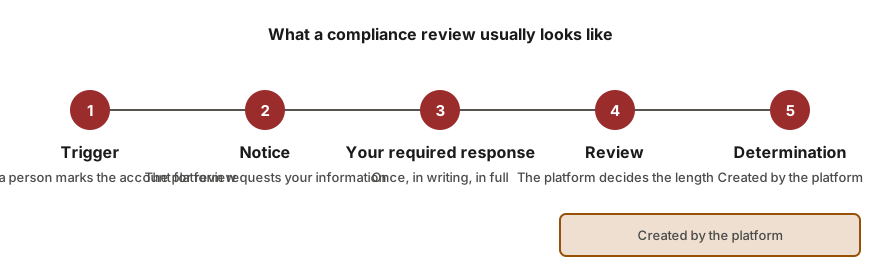
| A formal compliance examination of the account history | An account restriction affecting all funds and a requirement to provide the origin of assets | You must answer the precise inquiry. Our documentation detailing reasons for exchange restrictions outlines common triggers. |
| Network congestion or maintenance | A visible status banner or a transaction that awaits the required number of confirmations | Review the official platform status page and locate the transfer data using a public block explorer tool. |
Understanding the Travel Rule in Standard Terms
As a rule, when funds are transferred between two banks, identifying details concerning the sender and the receiver travel with the transfer. The travel rule applies this exact principle to digital currencies. When one cryptocurrency business moves assets to another business, it must submit specific identifying information about both parties. The receiving institution then acquires these details and performs an examination of the record.
This requirement originates from global anti-money-laundering standards, which have been translated into domestic rules by various nations. The specific data requirements vary. Certain jurisdictions apply this rule to all transactions, while others apply it only if the amount exceeds a specific threshold. Transfers directed toward private wallets are treated differently than those occurring between regulated businesses.
This rule mandates the sharing of information, not access to funds; none of your personal security credentials, such as seed phrases, private keys, or passwords, are required. The data necessitated by this rule typically encompasses the specific items listed below.
- The name of the sender and the wallet or account from which the funds depart.
- The name of the recipient and the wallet or account to which the funds arrive.
- In certain jurisdictions, an additional identifier for the sender, for example an address, a date of birth or an ID number.
- The name of the receiving business, where such a business exists.
What a platform may request about the recipient wallet
Once you register a withdrawal address, the platform may enquire who controls the receiving wallet. Your answer determines which checks apply. You should answer truthfully, since an inaccurate answer may result in a refused transfer or an extended review.
| What may be requested | Why the platform asks | How to prepare |
|---|---|---|
| Whether the wallet belongs to you or to another person | The procedure and the checks are not the same for a transfer to yourself as for a payment to a third party | Decide this before you begin. If the recipient is a third party, prepare their details in advance. |
| Whether the destination wallet is held at a different platform, or is one you control yourself | The platform may be required to share information with the receiving business, or to verify that the external wallet is one you personally control | Ascertain the name of the service listed within the receiving account record. If the wallet is private, you must identify the specific device or application holding those assets. |
| Recipient's full legal name | So that the exchange can compare it against the name on the receiving account | Request that the recipient copy the name from their verified profile, with identical spelling. |
| The name and country of the receiving platform | To deliver the information to the correct recipient and to follow the local requirements | Find it on the recipient's deposit page or within their account details. |
| Why the transfer is being made | This process involves assessing potential risk and documenting the rationale for the movement of transferred funds. | Write a single simple sentence, and attach the invoice or contract if the transfer relates to a payment. |
| Evidence that the private wallet is under your control | To rule out that another party controls the address | Pick a verification method the platform recognizes, for example a signed message or a small test transfer. Do not disclose your keys at any point. |
How to prepare before a withdrawal
Most holds are caused by unexpected conditions, and some advance preparation prevents many of them. Complete these steps before a large or first-time withdrawal, not once it is already delayed.
- Finish the identity procedure the platform provides, and confirm your profile details match your identification document.
- Register and label the withdrawal address beforehand, and state the wallet type correctly.
- In the days before a large withdrawal, as a rule you should not change your password, your device or your two-factor method.
- Send a small test amount first and confirm it arrives before sending more.
- Before withdrawing crypto bought with bank or card deposits, allow those deposits to settle first.
- Retain records showing how the account was funded, for example purchase receipts and bank statements.
- Do not break a single large transfer into several smaller ones in order to sidestep a check. In practice this pattern resembles concealment of activity, and it can extend the review period.
When the hold remains
You may request three things from the platform in writing: the category of hold applied, the information it requires, and the typical duration of its review. Submit one complete response, covering every request, via the channel it specified. Retain the ticket number.
Bypassing the hold by routing funds through other addresses or accounts is not advisable. That creates additional activity the platform must also account for. Should the answers remain unclear, or should the platform stay silent beyond the period it stated, a structured escalation can help.
Our role is to review the hold together with you, identify the category it most likely falls under, assemble the requested information, and prepare the reply or escalation in writing. We have no power to make a platform release funds, and we never request your seed phrase, private keys or passwords. The initial assessment costs nothing, and fees are discussed only after we have told you whether assistance is possible.
Frequently asked questions
How long does a withdrawal hold remain in place?
The duration depends on the underlying reason. A security delay usually runs for a fixed period that the platform itself announces. A compliance review can take more time, and as a rule it concludes once the requested records have been submitted. In practice you should ask the platform for its stated timeframe and keep that response in writing.
Does the travel rule give the exchange access to my private wallet?
No. The rule covers information about persons and accounts, for example names and wallet identifiers. An exchange can view public blockchain data in the same way as anyone else, but it receives no access to your keys or to the wallet itself.
Why did the exchange question my transfer to my own wallet?
The exchange may ask whether an address belongs to you, because its terms treat self-transfers differently from transfers to other parties. It may also screen the address for connections to risk. In practice you should answer truthfully and offer proof of control that discloses no secret.
Can using a private wallet exempt me from the travel rule?
In most jurisdictions you are permitted to keep your own coins in a private wallet, yet the exchange may still ask whether the address is yours and apply additional checks. As a rule, routing funds through other addresses to avoid the rule tends to prolong a review. This depends on the jurisdiction and the terms you accepted.
Would splitting a large withdrawal into smaller amounts help?
No. If you divide one transfer into smaller parts so that each part falls below a limit or a check, the platform may read this as an effort to conceal activity, and the review can take longer as a result. As a rule, it is better to send the amount in a single submission and include every detail the exchange requests.
How we can help
- Diagnosing who froze your crypto. Establish who froze your funds and which next step is realistic.
- Unblocking an exchange account. Understand the restriction, prepare KYC and AML evidence, reply and appeal.
- Disputing risk flags from wallet screening. High-risk address flag from screening tools: record the funds path and dispute it.
- Source of funds and wealth documentation packs. Build a clear source of funds and source of wealth pack for exchanges, banks and processors.
The content on this page is general in nature and is not legal advice.