
When a relative has passed away or lacks capacity, they may require coordinated access to digital assets.
Published: Last reviewed: Editorial standards
When an individual passes away or cannot manage assets, family members face difficulties locating digital holdings. The appropriate process involves necessary legal documentation, locating accounts, and complying with the exchange process. Independent technical and legal experts perform their respective work, which CryptoAppeals coordinates. We do not engage in bypassing security or passwords.
Any question on your case may be put to us here:
Technical work on this service is done by independent partner specialists. We vet them, coordinate the case and stay your single point of contact.
Who this service is meant for
- Suspecting a deceased relative held crypto but lacking records of the accounts.
- An exchange account is known, yet the authority demands documentation you cannot provide.
- A family member has lost capacity requiring lawful management and access to assets.
- As executor or administrator, obtaining a formal strategy for managing digital property.
The procedure for a case
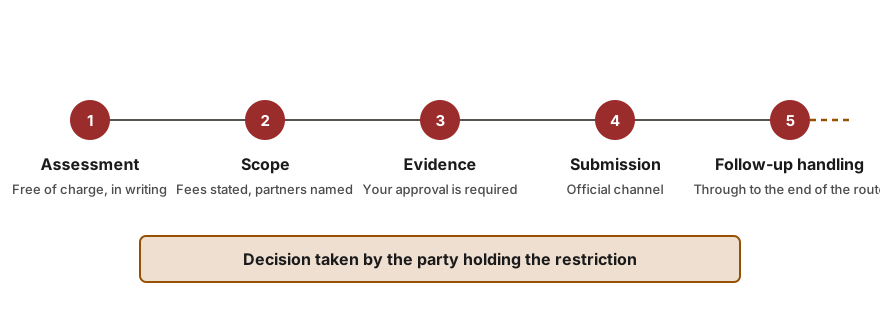
- Free initial assessment
Tell us who the person was, what you know and which papers you hold. We respond in writing on what appears possible, what a first legal step might be, and whether we are able to assist.
- Scope and initial introductions
Should you decide to proceed, we prepare a written scope with a fee model, then we connect you with the independent lawyer and the specialists handling the matter. You settle the terms with each of them directly and in writing.
- Records and legal preparation
You submit the required documents through a protected channel. A licensed lawyer then verifies the legal authority you possess or must obtain. The service compiles an inventory of the relevant platforms and devices to contact.
- Platform notices and technical steps
We submit written requests to the exchanges and, where required, hand devices or files to an independent specialist under agreed written terms. You receive copies of every piece of correspondence.
- Passing the assets to the estate
We set out in writing what was recovered and what was not, and assist the executor or the family in recording and securing the assets. Once this is done, we close the file.
What to prepare
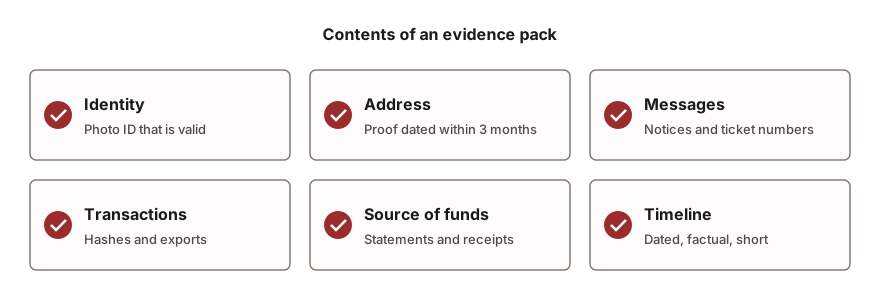
- Death certificate or medical evidence of incapacity, as the case requires
- Documentation of your authority: a court grant, a will, letters of administration or a power of attorney
- A government-issued photo ID and proof of your address
- Evidence of your relationship to the person, if the platform requests it
- Emails, bank statements and any devices that may indicate exchanges or wallets
- Any account names, email addresses or phone numbers known to be connected with crypto
- An inventory of devices, hardware wallets, wallet files and written notes that were located
What our work involves
- Record what may exist
With our help, you review emails, bank statements, devices and paper records for evidence of exchange accounts, wallets and purchases. We prepare a list of platforms to contact and a separate list of items that may require technical assistance.
- Establish the legal authority required
As a rule, exchanges require documentation regarding death, legal authority, and identity. Jurisdiction dictates these requirements, and a licensed attorney defines your specific case needs.
- Contact exchanges through their formal procedure
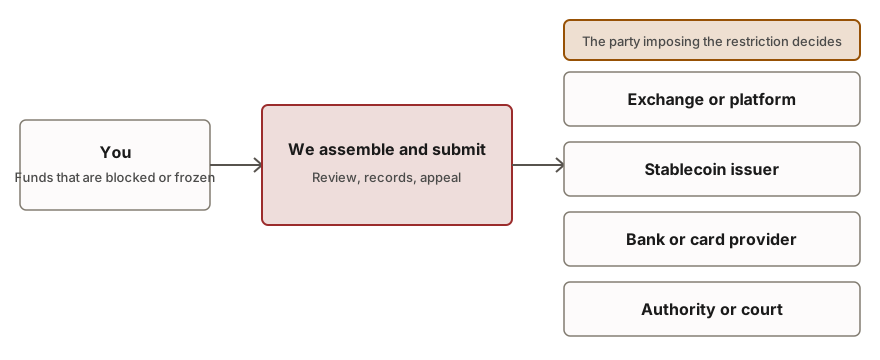
Assistance is available for preparing a submission to each exchange's deceased-account or incapacity team, with the documents arranged in the correct order. Every response received is kept on a written record.
- Engage independent lawyers and technical specialists
Licensed lawyers who work independently manage the legal procedures. When a wallet file or hardware device is part of the matter, approved independent specialists may attempt lawful access. Our role is to verify their credentials and arrange their tasks.
- Record and secure the assets
After assets are located, we assist you in documenting them for the estate, transferring them to wallets controlled by the rightful owner, and maintaining a clear audit trail for the executor, the family and any tax adviser.
What falls outside our role
- No exchange can be compelled by us to release an account, and we do not promise that any crypto will be located. Without keys, some assets are simply out of reach.
- We do not break into accounts, attempt to guess passwords or circumvent security. Our work proceeds only through lawful access and the platform's own procedure.
- Legal advice is provided by independent licensed lawyers, not by us, and the applicable rules vary by country.
- Neither you nor the deceased will ever be asked by us for a seed phrase, private keys or passwords.
Expected timeframes
Estate and incapacity matters run on legal timelines and platform queues, and several months may pass. Locating assets can move faster than obtaining a release from an exchange. An estimate follows the assessment, and we revise it as the matter progresses.
Fees
The assessment carries no charge. Lawyers and technical specialists set their own fees, and some technical work in this area is arranged on a success basis, though terms differ. Each fee is confirmed in writing before work begins, and no payment is requested before we state whether we can assist. Fees →
Frequently raised questions
How can I obtain access to a deceased person's crypto?
Begin with the legal basis and the documentation. As a rule, you need evidence of death together with evidence of your authority, and you then contact each exchange through its own process. Where wallets are self-held, the keys or a lawful technical route are required.
What can I do when I am not sure where the crypto is held?
Review your records for evidence such as exchange notifications, bank deposits made to cryptocurrency services, installed applications on a mobile device, physical hardware wallets, and handwritten documentation. Discovering the full set of platforms involved is commonly the initial substantive action. A portion of holdings might remain unrecoverable.
When a relative attempts communication regarding your account, will the exchange address the matter directly?
As a rule, the exchange will only speak to you once you submit legal documents. Most platforms operate a deceased-account procedure that requires a death certificate together with proof of your authority, such as papers a licensed lawyer has prepared. In practice, privacy rules prevent them from disclosing any details until that submission is complete and reviewed.
Is it possible to access the wallet if the password is missing?
No procedure involves unauthorized intrusion. When a wallet file or hardware device forms part of an estate, independent specialists may attempt lawful recovery, though no outcome is certain. Should both the private keys and the passphrase be absent, regaining access might not be possible.
Do I need a lawyer for this?
In many cases, yes. Control over an estate or over a person who cannot act is governed by law, and the procedure depends on the jurisdiction and the terms you accepted. An independent licensed lawyer confirms which documents are required, and our role is limited to coordinating the remaining steps.
How do I prevent this issue from affecting my own family?
You should maintain a secure record of your cryptocurrency holdings and inform a trusted individual how to locate that information, without writing seed phrases in unsecured notes. Licensed legal counsel should be consulted regarding a will or power of attorney that addresses digital assets.
Common situations
- Dealing with a deceased relative who had an exchange account but no recorded password.
- Hardware wallet discovered among personal effects, without a PIN or seed phrase
- Emails or bank statements suggesting crypto purchases, with no list of wallets
- An exchange that declines to deal with family members until a court order or grant is provided
- A relative who handled crypto alone and now lives with dementia or is recovering from a stroke
- An encrypted wallet file stored on an old computer belonging to the estate
Related situations
- Recovering a wallet password or file. Forgotten password or damaged wallet file: screened independent specialists attempt recovery.
- Hardware Wallet Recovery Assistance. Lost PIN or lost hardware wallet: clear options and vetted independent laboratories.
- Source of funds and wealth documentation packs. Build a clear source of funds and source of wealth pack for exchanges, banks and processors.
- Unblocking an exchange account. Understand the restriction, prepare KYC and AML evidence, reply and appeal.
Read next
The content on this page is general in nature and is not legal advice.