
Your account was closed or you were told to withdraw: getting your funds out
Published: Last reviewed: Editorial standards
As a rule, a platform that closes your account must still allow you to remove your assets, unless a legal or compliance hold applies. Problems arise when the closure notice and the withdrawal block arrive together. In practice, the workable procedure is to request the closure reason, the withdrawal option and a deadline in writing, keep a record of every response, and escalate through formal channels. We help you prepare each submission. We cannot compel a platform to pay out.
Any question on your case may be put to us here:
Who this service is meant for
- You were served an offboarding or closure notice, yet withdrawals remain disabled
- The platform states your account is closed but does not identify where your balance sits
- A withdrawal deadline was set, but the withdrawal function fails or is restricted
- Support responds only with templates and never names a reason or a next step
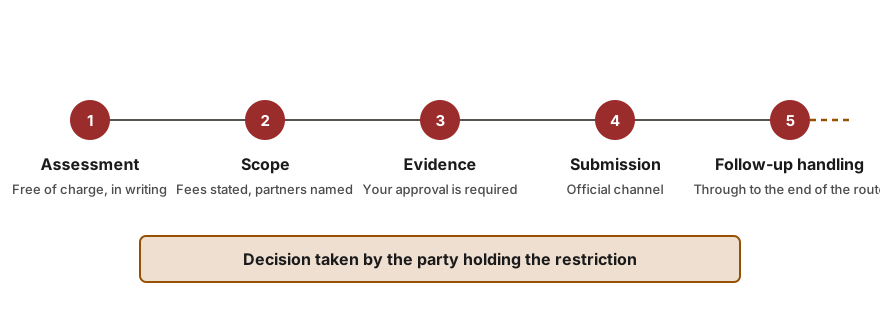
The procedure for a case
- Free initial assessment
Provide us with the closure notice together with a brief account of events. We answer in writing, describing what type of closure this appears to be, whether we can assist and which documents we would request.
- Scope in writing
Should you decide to continue, we provide the scope of work, the fee model and the names of the independent specialists involved. The choice to proceed rests with you. No charge applies at any point before that decision.
- Documents and records
You provide statements, screenshots and correspondence through a secure channel. We compare dates and amounts against one another and flag any gaps before a submission is made.
- Initial written request
We send the exchange a formal written request that asks for the reason for closure, the withdrawal procedure, and the applicable deadline. You receive a copy of that request and the ticket reference number.
- Final escalation and account closure
We monitor the response, prepare a next-level complaint if required and state plainly when the remaining options are limited or uncertain.
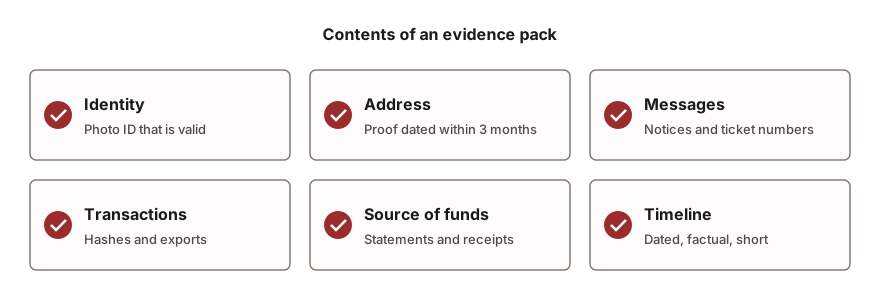
What to prepare
- The notice of closure or offboarding, showing the date and the sender address
- Every support ticket and chat transcript relating to the closure
- Account statements or transaction exports that show the balance
- The terms of service of the platform, as they stood when the account was opened
- Government-issued photo identification and proof of address that matches the account record
- Wallet or bank account details for the destination account you plan to use
- A brief chronology showing when the closure notice, the block and every response occurred
What our work involves
- Review the closure notice and the applicable terms
Review includes the closure notice, the governing terms, and all previous support correspondence. We distinguish between a standard offboarding, permitting withdrawal of funds, and a closure necessitated by an asset hold pending a review.
- Prepare a clear request in writing
The request includes the rationale for closure, precise withdrawal instructions, and supported transfer destinations. A formal written submission provides you with verifiable documentation that informal chat replies do not.
- Record the balance and build a timeline
Our team assists you in exporting statements, screenshots and dated correspondence that document the account contents and the moment the closure began. In practice, this record forms the foundation for each later submission.
- Clear the obstacle to withdrawal
Where the platform permits withdrawal yet a technical or compliance step blocks it, we help you identify what is missing, for example a verification gap or an unsupported address, and prepare a response in the format the platform accepts.
- Use formal escalation procedures
Should the platform not respond, we help you file its complaint procedure in writing, then approach a regulator or ombudsman where such a route exists, and engage an independent lawyer when the amount and facts justify that step.
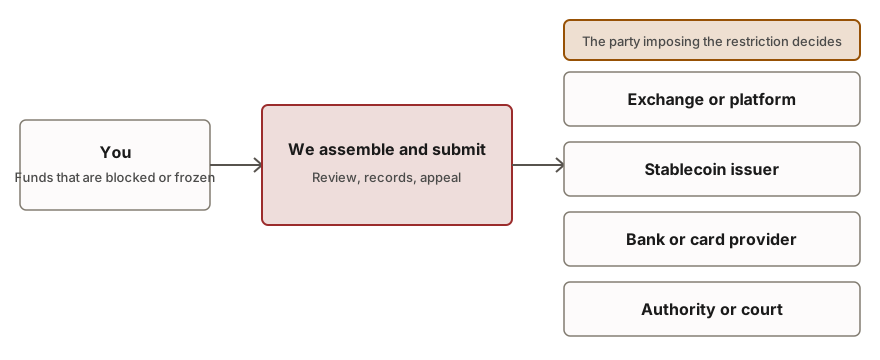
What falls outside our role
- We cannot compel a platform to release your balance. The platform decides under its own terms and the law that governs it.
- Where a legal or compliance hold is in force, the platform may be prohibited from paying out. We do not commit to any date or outcome.
- We do not assist with moving funds around a restriction or concealing where they came from.
- We will never request your seed phrase, private keys or account passwords.
Expected timeframes
Closure cases proceed at the pace set by the platform's support and compliance staff. A straightforward offboarding may finish quickly, but a closure connected to a review can run for weeks. You receive an estimate after the assessment, and we revise it as responses come in.
Fees
The assessment costs nothing. Once it is complete, you receive a written scope and a fee model for your matter. No fee is requested before we have told you whether we are able to assist. Fees →
Frequently raised questions
Can an exchange close an account that still holds funds?
Under the terms you accepted, exchanges can close accounts. Generally, they must permit asset withdrawal, unless a legal or compliance hold applies. You should review the notice carefully.
What specific information regarding your situation should you request in writing?
Request the closure basis, hold status, and specific withdrawal procedures and deadlines. Obtain a formal written response and record the ticket number provided.
If the exchange instructs you to withdraw but the designated function fails, what is the appropriate course of action?
Document the error with dated screenshots and report the failure via the official ticket system. Request an alternative withdrawal route in writing.
Does the designation of a closed account equate to the status of a frozen account?
Frozen accounts are restricted awaiting review, whereas closed accounts indicate the termination of the relationship. Overlapping statuses may lead to delayed payouts.
What is the potential consequence if the deadline stipulated in the official notice is missed?
Immediate loss is unlikely, but you should act promptly. Submit a written request before the date seeking an extension for your withdrawal.
Is it possible to file a complaint with a regulatory authority?
That varies. The answer turns on your place of residence and on whether the platform holds a licence there. Certain jurisdictions provide a financial ombudsman or a consumer authority that will accept a complaint of this kind. We review which options are open in your situation.
Common situations
- Notification that the service is departing your country and every user must withdraw
- The exchange ceased operations on the account following a compliance review, leaving remaining funds within the ledger.
- Transfers may occur solely to a designated bank account or wallet that you presently cannot utilize.
- You received a closure notice outlining a brief deadline, but you cannot currently access the platform interface.
- The authority states that on the closed account, funds will remain secured until the review concludes.
- Closing a business account when the platform has revised its risk rules
- The account contained a balance in a specific token which the platform delisted prior to account closure.
Related situations
- Diagnosing who froze your crypto. Establish who froze your funds and which next step is realistic.
- Unblocking an exchange account. Understand the restriction, prepare KYC and AML evidence, reply and appeal.
- Source of funds and wealth documentation packs. Build a clear source of funds and source of wealth pack for exchanges, banks and processors.
- Filing complaints with a regulator or an ombudsman. Draft a structured complaint to the regulator, ombudsman or consumer body, with a clear chronology.
Read next
Sources
Authoritative and official pages on which this page relies. Such pages are updated, so confirm the current wording at the source itself.
- Does Coinbase freeze accounts? · Coinbase
- Why is my account restricted? · Kraken
The content on this page is general in nature and is not legal advice.