
Review of AML Compliance Policies, Risk Assessments, and Programs for Digital Asset Businesses
Published: Last reviewed: Editorial standards
An anti-money laundering (AML) program must accommodate the specific risks of your crypto business, requiring written assessments and formalized policies. We coordinate independent specialists to assist in developing or reviewing this program. It must be stated that CryptoAppeals is not a regulated auditor, a licensed Money Laundering Reporting Officer, or a law firm, and no definitive outcome regarding regulator or bank decisions can be promised.
Any question on your case may be put to us here:
Who this service is meant for
- Founders of cryptocurrency start-ups who are obligated to establish AML policies prior to engagement with a regulator, bank, or payment partner.
- Compliance officers seeking a formalized secondary review of existing policy sets or current risk assessments.
- Finance and operations leaders required to furnish AML documentation requested by a financial institution or a payment partner.
- Teams that experienced rapid expansion and currently operate utilizing templates that do not align with their current product specifications.
- Owners who require preparation for an impending audit, a partner review, or inquiries from a regulatory authority.
The procedure for a case
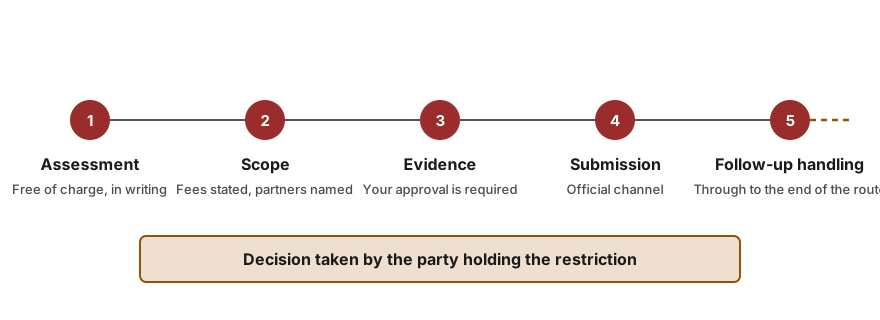
- Free initial assessment
In writing, you describe what the business does, who requested what and the reason. We state whether independent compliance specialists can assist and which records they would need to review.
- Scope and fee in writing
Before payment is taken, you receive a written submission setting out the scope, the proposed specialists, the deliverables and the fee model. The parties agree, in writing, what falls inside the scope and what does not.
- Initial fact-gathering
Independent specialists review your records and hold discussions with your team. As a rule, you receive a list of questions together with a deadline for your responses.
- Prepare draft deliverables
Drafts of the documents, or a gap report, are prepared by the specialists. We then review each draft for clarity and fit with your facts, and afterwards walk your team through the contents.
- Handoff
Final versions come to you with an action list naming the owner of each task and a note of what remains open. In practice, ownership of the programme rests with your named compliance officer.
What to prepare
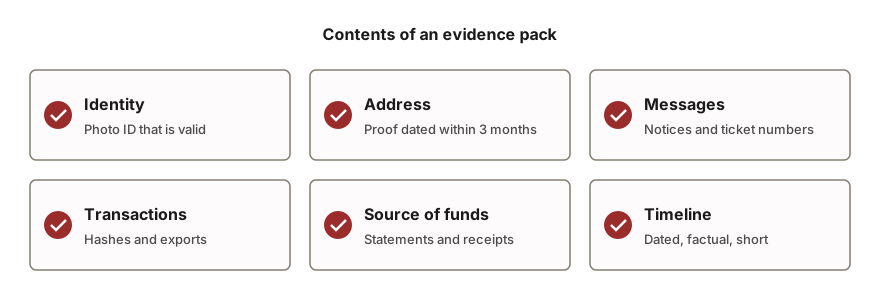
- A brief description of the products, services, customer types and countries served
- Current AML, KYC, sanctions and monitoring policies, including drafts
- Your most recent risk assessment, where one exists, plus the date it was last updated
- An organisation chart identifying which people occupy compliance, management and board positions
- Onboarding forms and alert samples with all personal data removed
- Your KYC, screening and analytics vendors, together with the purpose each one serves
- Requests or inquiries sent by a regulator, an auditor, a bank or a payment partner
- Details of any licence or registration you currently hold, if applicable
What our work involves
- Map your business model and its risk exposure
The specialists commence by reviewing your accepted terms, encompassing products, customer base, geography, payment methods, and underlying technology. An analysis of facts and interviews determines applicable risks, ensuring the program aligns with your specific operations, not a general template.
- Prepare or examine the risk assessment
Independent specialists assist you in drafting a business-wide risk assessment that scores customer, product, geography and delivery risks and links each score to a control. Where a document already exists, they examine it for gaps, outdated assumptions and absent evidence.
- Compare written policies with daily practice
Our team sets your written policies for onboarding, screening, monitoring, record keeping and escalation beside what staff do in practice. You receive the gaps in plain wording and a list of actions. A licensed lawyer confirms which legal rules apply to you.
- Advise on tool selection
Our role is to help you draft the requirements a vendor must meet for KYC, sanctions screening, blockchain analytics and case management. Once those are written, you can weigh each option against the list and set up a trial period. The purchase decision and the contract itself remain yours, not ours.
- Train staff and draft responses
Our team prepares brief staff briefings and a list of questions a bank, auditor or supervisor is likely to raise, together with draft answers drawn from your own documents. Every answer remains yours to own.
What falls outside our role
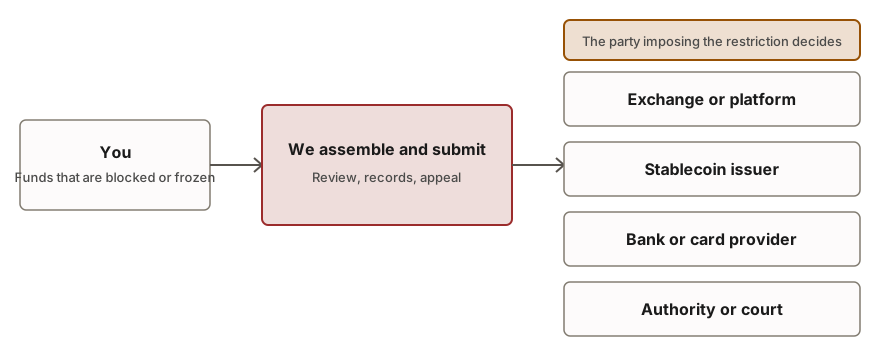
- Our role is advisory only: we are not a regulated auditor, not a licensed money laundering reporting officer and not a law firm. We provide no legal advice, and we do not certify compliance.
- We do not serve as your compliance officer, make customer decisions on your behalf or submit reports to any authority for you. Those duties remain yours.
- No regulator, bank or auditor is obliged to accept your documents or reach a particular conclusion, and we make no commitment regarding a licence, an account or an approval.
- Any review we coordinate is advisory in nature. It does not replace an independent audit, nor any examination that the law requires a qualified party to perform.
- The intake procedure does not require seed phrases, private keys or passwords, and no one on our side can or does access customer wallets or funds.
Expected timeframes
The schedule depends on the size of the business, how many products it covers and how quickly your team responds to questions. A focused review takes less time than a complete policy set. Dates are fixed in the written scope, and if anything slips, we notify you early.
Fees
The assessment is free of charge. Once it is done, we send you the scope and the fee model in writing, with the independent specialists' fees listed separately. Nothing is invoiced until we have confirmed whether we can assist and you have accepted the scope in writing. Fees →
Frequently raised questions
Which components make up an AML programme for a company operating in crypto?
As a rule it covers a business-wide risk assessment, written policies, customer due diligence, screening for sanctions and addresses, transaction monitoring, record keeping, staff training and a named responsible person. The exact content depends on your products, your customers and the rules that apply to you, which your lawyer confirms.
Could you serve as our compliance officer or MLRO?
No. We are not a licensed officer and we do not accept that role. Your business retains its own named compliance officer, who owns the decisions and the filings. Independent specialists may assist that person with reviews, drafts and training.
Can you promise our business will pass a regulator's review?
The regulatory authorities, financial institutions, and auditors make the final decision themselves. CryptoAppeals assists you by preparing clear, consistent submissions for their consideration. We can also structure responses regarding anticipated inquiries. We do not offer any promises concerning approval or a specific outcome.
Which rules apply to my business?
The answer rests on three points: the jurisdiction where you do business, the services you provide, and the customer base you serve. We do not offer legal advice on this question. Your lawyer, or written guidance issued by the supervisor, confirms which rules apply, and after that the specialists align your documents with the checklist you supply.
In what way does a programme differ from a template?
A template supplies you with headings only. A programme additionally requires a risk assessment that mirrors your real products and customers, controls your staff actually observe, and records demonstrating that they did so. We check your documents against the way the business operates in practice.
Do you require access to our customer data?
Not initially. Specialists proceed on the basis of policies, process descriptions and samples from which personal data has been removed. Where a review requires actual records, that is agreed in writing beforehand, and access is confined to what the task demands.
Common situations
- A financial institution or payment processor requires documentation detailing your AML policy, risk assessment, and control mechanisms.
- Introducing a new service, like staking or listing a new token, may necessitate an updated risk assessment.
- Delays or inconsistencies in customer onboarding often result from an ambiguous KYC procedure.
- Monitoring systems generate alerts that accumulate without defined written protocols for their handling.
- Following findings raised by a regulator or auditor, a specific remediation plan becomes necessary.
- A policy based on a generic template may not appropriately reflect the specific operations of your exchange.
- If a new compliance officer assumes responsibility, a formal, structured handover of records is often required.
Related situations
- Crypto firm due diligence and risk reviews. Evidence-based, written checks on customers, counterparties and wallets, each with a documented risk rating.
- Transaction monitoring advisory for crypto companies. Build scenarios, thresholds and alert procedures covering on-chain and off-chain activity.
- Report on blockchain transaction analysis. A source-of-funds report based on transaction tracing, prepared in a form a compliance team can review.
- Disputing risk flags from wallet screening. High-risk address flag from screening tools: record the funds path and dispute it.
Read next
Sources
Authoritative and official pages on which this page relies. Such pages are updated, so confirm the current wording at the source itself.
- Application of FinCEN's Regulations to Certain Business Models Involving Convertible Virtual Currencies (FIN-2019-G001) · Financial Crimes Enforcement Network (FinCEN)
- Cryptoassets: AML / CTF regime · Financial Conduct Authority
- Guidelines amending the ML/TF Risk Factors Guidelines (EBA/GL/2024/01) · European Banking Authority
The content on this page is general in nature and is not legal advice.